

Security-Operations-Engineer Study Guide: Latest [Jun 10, 2026] Realistic Verified Security-Operations-Engineer Dumps
Security-Operations-Engineer Questions & Practice Test are Available On-Demand
NEW QUESTION # 61
You are developing a new detection rule in Google Security Operations (SecOps). You are defining the YARA-L logic that includes complex event, match, and condition sections. You need to develop and test the rule to ensure that the detections are accurate before the rule is migrated to production. You want to minimize impact to production processes. What should you do?
- A. Develop the rule in the Rules Editor, define the sections of the rule logic, and test the rule by setting it to live but not alerting. Run a YARA-L retrohunt from the rules dashboard.
- B. Use Gemini in Google SecOps to develop the rule by providing a description of the parameters and conditions, and transfer the rule into the Rules Editor.
- C. Develop the rule logic in the UDM search, review the search output to inform changes to filters and logic, and copy the rule into the Rules Editor.
- D. Develop the rule in the Rules Editor, define the sections the rule logic, and test the rule using the test rule feature.
Answer: C
Explanation:
The safest way to minimize production impact is to develop and refine the rule logic in UDM search first. By running searches and reviewing outputs, you can iteratively tune filters and conditions until the detections are accurate. Once validated, you then copy the tested query into the Rules Editor. This approach ensures accuracy without risking false positives or unnecessary load in production.
NEW QUESTION # 62
You are investigating an alert in Google Security Operations (SecOps). You want to view previous enrichment attributes and relevant historical cases for an entity using the fewest number of steps. What should you do?
- A. Initiate a SOAR Search to query the entity.
- B. Select the entity identifier in the Entity Highlights widget to open Entity Explorer.
- C. Select View Details for the entity in the Entity Highlights widget.
- D. Initiate a SIEM Search to query the entity.
Answer: B
Explanation:
The most efficient method is to select the entity identifier in the Entity Highlights widget to open Entity Explorer. Entity Explorer consolidates enrichment attributes, historical cases, and contextual relationships in one place, allowing you to quickly view past activity and investigations with minimal steps.
NEW QUESTION # 63
You are developing a security strategy for your organization. You are planning to use Google Security Operations (SecOps) and Google Threat Intelligence (GTI). You need to enhance the detection and response across multi-cloud and on-premises systems. How should you integrate these products?
Choose 2 answers
- A. Use Google SecOps SOAR integrations with GTI for event enrichment.
- B. Ingest on-premises and cloud security logs into Google SecOps SIEM as entities.
- C. Ingest on-premises and cloud security logs into Google SecOps SIEM as events.
- D. Use Google SecOps SOAR integrations with GTI for entity enrichment.
- E. Ingest GTI IOCs into Google SecOps as security events.
Answer: A,C
Explanation:
Comprehensive and Detailed Explanation
The correct answers are B and D, as they accurately describe the two primary functions of a modern SecOps platform: SIEM (Detection) and SOAR (Response).
* Option B: (Detection Strategy) A SIEM's fundamental purpose is to perform detection. To do this, it must first ingest telemetry (logs) as events. This is the foundational step for any detection and response strategy. Logs from all sources-on-premises (e.g., firewalls, Active Directory) and multi- cloud (e.g., AWS CloudTrail, Azure Activity Logs)-are ingested into Google SecOps, normalized into the Unified Data Model (UDM), and stored as events. This is what allows detection rules to run.
(Option C is incorrect as logs are events, not entities).
* Option D: (Response Strategy) A SOAR's fundamental purpose is to orchestrate and automate the response to a detection. A key part of this response is event enrichment (or more specifically, observable enrichment). When an alert is ingested by the SOAR, a playbook runs. This playbook uses integrations (e.g., with Mandiant or VirusTotal, which are part of GTI) to query for real-time context on the observables (IPs, hashes, domains) in the alert. This enrichment helps an analyst make a decision or allows the playbook to automate a containment action.
Option A is incorrect because GTI is ingested as context (in the entity graph and Fusion Feed), not as events.
Option E is incorrect because "entity enrichment" (e.g., adding user data from AD) happens at the SIEM ingestion level, whereas SOAR integrations perform on-demand enrichment for alerts/events.
Exact Extract from Google Security Operations Documents:
Google SecOps data ingestion: Google Security Operations ingests customer logs, normalizes the data, and detects security alerts. Google SecOps ingests data using... Forwarders, Bindplane agent, Ingestion APIs, Google Cloud. Parsers convert logs from customer systems into a Unified Data Model (UDM) events.
Integrate Mandiant Threat Intelligence with Google SecOps: This document provides guidance on how to integrate Mandiant Threat Intelligence with Google Security Operations (Google SecOps). After you configure an integration instance, you can use it in playbooks.
Actions:
* Enrich Entities: Use the Enrich Entities action to enrich entities using the information from Mandiant Threat Intelligence. This action runs on the following Google SecOps entities: Hostname, IP Address, URL, File Hash.
* Enrich IOCs: Use this action to enrich indicators of compromise.
References:
Google Cloud Documentation: Google Security Operations > Documentation > SecOps > Google SecOps data ingestion Google Cloud Documentation: Google Security Operations > Documentation > SOAR > Marketplace integrations > Mandiant Threat Intelligence
NEW QUESTION # 64
You have a close relationship with a vendor who reveals to you privately that they have discovered a vulnerability in their web application that can be exploited in an XSS attack. This application is running on servers in the cloud and on-premises. Before the CVE is released, you want to look for signs of the vulnerability being exploited in your environment. What should you do?
- A. Create a YARA-L 2.0 rule to detect a time-ordered series of events where an external inbound connection to a server was followed by a process on the server that spawned subprocesses previously not seen in the environment.
- B. Ask the Gemini Agent in Google Security Operations (SecOps) to search for the latest vulnerabilities in the environment.
- C. Activate a new Web Security Scanner scan in Security Command Center (SCC), and look for findings related to XSS.
- D. Create a YARA-L 2.0 rule to detect high-prevalence binaries on your web server architecture communicating with known command and control (C2) nodes. Review inbound traffic from those C2 domains that have only started appearing recently.
Answer: A
Explanation:
The correct approach is to create a YARA-L 2.0 rule that detects a sequence of events where an external inbound connection to a server is followed by a process spawning previously unseen subprocesses. This behavior-based detection can identify potential exploitation of the XSS vulnerability in your environment before a CVE is publicly released, without relying on signatures or external threat intelligence.
NEW QUESTION # 65
A Google Security Operations (SecOps) detection rule is generating frequent false positive alerts.
The rule was designed to detect suspicious Cloud Storage enumeration by triggering an alert whenever the storage.objects.list API operation is called using the api.operation UDM field.
However, a legitimate backup automation tool that uses the same API, causing the rule to fire unnecessarily. You need to reduce these false positives from this trusted backup tool while still detecting potentially malicious usage. How should you modify the rule to improve its accuracy?
- A. Adjust the rule severity to LOWto deprioritize alerts from automation tools.
- B. Convert the rule into a multi-event rule that looks for repeated API calls across multiple buckets.
- C. Add principal.user.email != "[email protected]" to the rule condition to exclude the automation account.
- D. Replace api.operation with api.service_name = "storage.googleapis.com" to narrow the detection scope.
Answer: C
Explanation:
The most accurate way to reduce false positives is to exclude the known trusted backup automation account by adding a condition such as principal.user.email != "backup- [email protected]". This keeps the rule active for all other accounts, ensuring you still detect suspicious or malicious Cloud Storage enumeration while preventing unnecessary alerts from legitimate automation.
NEW QUESTION # 66
Your organization has recently onboarded to Google Cloud with Security Command Center Enterprise (SCCE) and is now integrating it with your organization's SOC. You want to automate the response process within SCCE and integrate with the existing SOC ticketing system. You want to use the most efficient solution. How should you implement this functionality?
- A. Configure the SCC notifications feed to send alerts to a Cloud Storage bucket. Create a Dataflow job to read the new files, extract the relevant information, and send the information to the SOC ticketing system.
- B. Evaluate each event within the SCC console. Create a ticket for each finding in the ticketing system, and include the remediation steps.
- C. Disable the generic posture finding playbook in Google Security Operations (SecOps) SOAR and enable the playbook for the ticketing system. Add a step in your Google SecOps SOAR playbook to generate a ticket based on the event type.
- D. Use the SCC notifications feed to send alerts to Pub/Sub. Ingest these feeds using the relevant SIEM connector.
Answer: C
Explanation:
Comprehensive and Detailed Explanation
The correct answer is Option C. The prompt asks for the most efficient and automated solution for handling SCCE findings and integrating with a ticketing system. This is the primary use case for Google Security Operations SOAR.
The native workflow is as follows:
* SCCE detects a finding.
* The finding is automatically ingested into Google SecOps SIEM, which creates an alert.
* The alert is automatically sent to SecOps SOAR, which creates a case.
* The SOAR case automatically triggers a playbook.
Option C describes this process perfectly. An administrator would disable the default playbook and enable a specific playbook that uses a pre-built integration (from the Marketplace) for the organization's ticketing system (e.g., ServiceNow, Jira). This playbook would contain an automated step to generate a ticket, thus fulfilling the requirement efficiently.
Option B is a manual process. Options A and D describe complex, custom-built data engineering pipelines, which are far less efficient than using the built-in SOAR capabilities.
Exact Extract from Google Security Operations Documents:
SOAR Playbooks and Integrations: Google SecOps SOAR is designed to automate and orchestrate responses to alerts. When an alert from a source like Security Command Center (SCC) is ingested and creates a case, it can be configured to automatically trigger a playbook.
Ticketing Integration: A common playbook use case is integration with an external ticketing system. Using a pre-built integration from the SOAR Marketplace, an administrator can add a step to the playbook (e.g., Create Ticket). This action will automatically generate a ticket in the external system and populate it with details from the alert, such as the finding, the affected resources, and the recommended remediation steps.
This provides a seamless, automated workflow from detection to ticketing.
References:
Google Cloud Documentation: Google Security Operations > Documentation > SOAR > Use cases > Case Management Google Cloud Documentation: Google Security Operations > Documentation > SOAR > Marketplace integrations
NEW QUESTION # 67
You are helping a new Google Security Operations (SecOps) customer configure access for their SOC team.
The customer's Google SecOps administrators currently have access to the Google SecOps instance. The customer is reporting that the SOC team members are not getting authorized to access the instance, but they are able to authenticate to the third-party identity provider (IdP). How should you fix the issue?
Choose 2 answers
- A. Grant the roles/chronicle.viewer role to the SOC team's IdP group in IAM.
- B. Grant the Basic permission to the appropriate IdP groups in the Google SecOps SOAR Advanced Settings.
- C. Link Google SecOps to a Google Cloud project with the Chronicle API.
- D. Connect Google SecOps with the third-party IdP using Workforce Identity Federation.
- E. Grant the appropriate data access scope to the SOC team's IdP group in IAM.
Answer: A,B
Explanation:
Comprehensive and Detailed Explanation
This scenario describes a common configuration task where authorization is failing despite successful authentication. The problem stems from the fact that Google SecOps uses a dual-authorization model: one for the main platform (SIEM/Chronicle) and a separate one for the SOAR module. The SOC team needs both.
The prompt states admins already have access, which confirms that prerequisite steps like linking the project (Option A) and configuring Workforce Identity Federation (Option B) are already complete. The problem is specific to the new SOC team's group.
* Fixing Instance Access (Option D):
The error "not getting authorized to access the instance" refers to the primary Google Cloud-level authorization. Access to the Google SecOps application itself is controlled by Google Cloud IAM roles on the linked project.1 The SOC team's group, which is federated from the third-party IdP, is represented as a principalSet in IAM. This principalSet must be granted an IAM role to allow sign-in. The roles/chronicle.
viewer role is the minimum predefined role required to grant this application access.
* Fixing SOAR Access (Option E):
Simply granting the IAM role (Option D) is not enough for the SOC team to perform its job. That role only gets them into the main SIEM interface. The SOAR module (for case management and playbooks) has its own internal role-based access control system. An administrator must also navigate within the SecOps platform to the SOAR Advanced Settings > Users & Groups and grant the SOC team's federated group a SOAR-specific permission, like "Basic" or "Analyst." Both steps are required to fully "fix the issue" and provide the SOC team with functional access to the platform.
Exact Extract from Google Security Operations Documents:
Identity and Access Management: Access to a Google SecOps instance using a third-party IdP relies on Workforce Identity Federation, but authorization is configured in two distinct locations.
* Google Cloud IAM: Authorization to the main SecOps instance (including the SIEM interface) is controlled by Google Cloud IAM.2 The federated identities (groups) from the third-party IdP are mapped to a principalSet. This principalSet must be granted an IAM role on the Google Cloud project linked to the SecOps instance. The roles/chronicle.viewer role is the minimum predefined role required to grant sign-in access.
* Google SecOps SOAR: Authorization for the SOAR module (for case management and playbooks) is managed independently.3 An administrator must navigate to the SOAR Advanced Settings > Users & Groups and assign a SOAR-specific role (e.g., 'Basic' or 'Analyst') to the same federated IdP group.
References:
Google Cloud Documentation: Google Security Operations > Documentation > Onboard > Configure a third-party identity provider Google Cloud Documentation: Google Security Operations > Documentation > SOAR > SOAR Administration > Users and Groups
NEW QUESTION # 68
You are using Google Security Operations (SecOps) to investigate suspicious activity linked to a specific user. You want to identify all assets the user has interacted with over the past seven days to assess potential impact. Your need to understand the user's relationships to endpoints, service accounts, and cloud resources. How should you identify user-to-asset relationships in Google SecOps?
- A. Run a retrohunt to find rule matches triggered by the user.
- B. Use the Raw Log Scan view to group events by asset ID.
- C. Query for hostnames in UDM Search and filter the results by user.
- D. Generate an ingestion report to identify sources where the user appeared in the last seven days.
Answer: C
Explanation:
The correct approach is to query UDM Search for hostnames (or other asset identifiers) and filter results by the specific user. UDM normalizes logs into a common schema, allowing you to trace the user's interactions across endpoints, service accounts, and cloud resources within the seven- day window. This provides a comprehensive view of user-to-asset relationships for impact assessment.
NEW QUESTION # 69
You are ingesting and parsing logs from an SSO provider and an on-premises appliance using Google Security Operations (SecOps). Users are tagged as "restricted" by an internal process. Restrictions last five days from the most recent flagging time. You need to create a rule to detect when restricted users log into the appliance. Your solution must be quickly implemented and easily maintained.
What should you do?
- A. Use a SOAR job to dynamically build and deploy a new version of the detection rule with the updated list of flagged users.
- B. Use a Google SecOps SOAR global context value to store a list of flagged users with their corresponding time-to-live values.
- C. Store the flagged users in a data table column with their corresponding time-to-live values in a second column. Use row-based comparisons in the detection rule.
- D. Create a regex data table to store each user and the corresponding time-to-live value in a single row, pipe-delimited, and use an "in" keyword in your detection rule.
Answer: C
Explanation:
Comprehensive and Detailed 150 to 250 words of Explanation From Exact Extract Google Security Operations Engineer documents:
This scenario is best addressed using Data Tables (formerly Reference Lists), which allow for dynamic list management with built-in expiration capabilities directly accessible by the Detection Engine.
According to Google Security Operations documentation regarding Data Tables: "Data tables are multicolumn data constructs that let you input your own data into Google Security Operations. They can act as lookup tables with defined columns and the data stored in rows." The prompt specifically requires handling a restriction period where "Restrictions last five days from the most recent flagging time." Data tables natively support this via Time-to-Live (TTL) settings. The documentation states: "You can specify a Time To Live (TTL) for list entries. When the TTL expires, the entry is automatically removed from the list." Furthermore, "TTL applied at the table level is inherited by the rows.
Any update to existing rows resets the TTL for that row," which perfectly automates the maintenance requirement.
To detect the login, you utilize row-based comparisons in YARA-L. The documentation explains the syntax for joining events with tables: "Using an equality operator ( =, != , >, >=, <, <= ) for row-based comparison.
For example, $udm_variable.field_path = %data_table_name.column_name." This allows the rule to dynamically check the incoming user against the active "restricted" list without modifying the rule text itself, ensuring the solution is easily maintained.
References: Google Security Operations Documentation > Investigation > Use data tables; Google Security Operations Documentation > Detection > YARA-L 2.0 Language Syntax
NEW QUESTION # 70
You are managing the integration of Security Command Center (SCC) with downstream tooling.
You need to pull security findings from SCC and import those findings as part of Google Security Operations (SecOps) SOAR actions. You need to configure the connection between SCC and Google SecOps. What should you do?
- A. Install the Google Rapid Response integration from the Google SecOps Marketplace. Gather information about the findings from the appropriate server.
- B. Install the SCC integration from the Google SecOps Marketplace. Grant the SCC API the appropriate IAM roles to integrate with the Google SecOps instance. Configure this integration using a generated API key scoped to the SCC API.
- C. Create a Pub/Sub topic with a NotificationConfig object and a push subscription for the desired finding types. Create a new Google SecOps service account in the Google Cloud project, and grant this service account the appropriate IAM roles to read from this subscription. Export the credentials from IAM and import the credentials into Google SecOps SOAR.
- D. Create a Pub/Sub topic with a NotificationConfig object and a push subscription for the desired finding types. Grant the Google SecOps service account the appropriate IAM roles to read from this subscription.
Answer: B
Explanation:
The proper way to integrate SCC findings into Google SecOps SOAR is to install the SCC integration from the Google SecOps Marketplace. You must grant the SCC API the appropriate IAM roles so that Google SecOps can access the findings, and configure the integration using a generated API key scoped to the SCC API. This approach provides a managed, secure, and supported method for importing SCC findings into SecOps actions.
NEW QUESTION # 71
Your company uses Google Security Operations (SecOps) Enterprise and is ingesting various logs. You need to proactively identify potentially compromised user accounts. Specifically, you need to detect when a user account downloads an unusually large volume of data compared to the user's established baseline activity.
You want to detect this anomalous data access behavior using minimal effort. What should you do?
- A. Develop a custom YARA-L detection rule in Google SecOps that counts download bytes per user per hour and triggers an alert if a threshold is exceeded.
- B. Create a log-based metric in Cloud Monitoring, and configure an alert to trigger if the data downloaded per user exceeds a predefined limit. Identify users who exceed the predefined limit in Google SecOps.
- C. Enable curated detection rules for User and Endpoint Behavioral Analytics (UEBA), and use the Risk Analytics dashboard in Google SecOps to identify metrics associated with the anomalous activity.
- D. Inspect Security Command Center (SCC) default findings for data exfiltration in Google SecOps.
Answer: C
Explanation:
The requirement to detect activity that is *unusual* compared to a *user's established baseline* is the precise definition of **User and Endpoint Behavioral Analytics (UEBA)**. This is a core capability of Google Security Operations Enterprise designed to solve this exact problem with **minimal effort**.
Instead of requiring analysts to write and tune custom rules with static thresholds (like in Option A) or configure external metrics (Option B), the UEBA engine automatically models the behavior of every user and entity. By simply **enabling the curated UEBA detection rulesets**, the platform begins building these dynamic baselines from historical log data.
When a user's activity, such as data download volume, significantly deviates from their *own* normal, established baseline, a UEBA detection (e.g., `Anomalous Data Download`) is automatically generated. These anomalous findings and other risky behaviors are aggregated into a risk score for the user. Analysts can then use the **Risk Analytics dashboard** to proactively identify the highest-risk users and investigate the specific anomalous activities that contributed to their risk score. This built-in, automated approach is far superior and requires less effort than maintaining static, noisy thresholds.
*(Reference: Google Cloud documentation, "User and Endpoint Behavioral Analytics (UEBA) overview";
"UEBA curated detections list"; "Using the Risk Analytics dashboard")*
NEW QUESTION # 72
You are implementing Google Security Operations (SecOps) at your organization. You discover that the current detection rules are too noisy. Due to the high volume of alerts, some true positives might be missed. You want to ingest additional context sources to reduce false positives in your security detections and to improve the overall positive ratio of the alerts. What should you do?
- A. Ingest high-value asset (HVA) data from your configuration management database (CMDB) system to increase the priority of the alerts based on the sensitivity of the assets found in the detection rules.
- B. Ingest tactics, techniques, and procedures (TTPs) from your threat intelligence system to validate the processes and tools with the detection rules.
- C. Ingest IOCs from your threat intelligence system to validate the IP addresses, domains and hashes with the detection rules.
- D. Ingest dark web forum handlers from your threat intelligence system to match dark web principals within the detection rules.
Answer: A
Explanation:
Ingesting high-value asset (HVA) data from the CMDB allows Google SecOps to prioritize alerts based on the sensitivity and criticality of the affected systems. This reduces noise by helping analysts focus on detections involving critical assets, improving the signal-to-noise ratio and ensuring true positives on important systems are not missed.
NEW QUESTION # 73
Your organization has recently onboarded to Google Cloud with Security Command Center Enterprise (SCCE) and is now integrating it with your organization's SOC. You want to automate the response process and integrate with the existing SOW ticketing system. How should you implement this functionality?
- A. Configure the SCC notifications feed to use Pub/Sub for alerts. Create a Cloud Run function to trigger when an event arrives in the topic and generate a ticket by calling the API endpoint in the SOC ticketing system.
- B. Evaluate each event within the SCC console. Create a ticket for each finding in the ticketing system, and include the remediation steps.
- C. Use the SCC notifications feed to send alerts to Pub/Sub. Ingest these feeds using the relevant SIEM connector.
- D. Disable the generic posture finding playbook in Google Security Operations (SecOps) SOAR and enable the playbook for the ticketing system. Add a step in your Google SecOps SOAR playbook to generate a ticket based on the event type.
Answer: A
Explanation:
The correct solution is to configure the SCC notifications feed to Pub/Sub and then use a Cloud Run function triggered by new events in the topic to call the SOC ticketing system's API. This automates ticket creation for findings, integrates seamlessly with the existing SOC process, and minimizes manual intervention while ensuring timely response.
NEW QUESTION # 74
Your company recently started pulling JSON logs from a third-party system into Google Security Operations (SecOps). You noticed that some fields are missing, and you want to parse them into UDM fields as quickly as possible. What should you do?
- A. Configure auto extraction to add the additional fields.
- B. Create parser extensions using the no-code approach.
- C. Create parser extensions using the code snippet approach.
- D. Submit a parser improvement request to Cloud Customer Care.
Answer: B
Explanation:
The fastest way to handle missing fields in JSON logs is to create parser extensions using the no- code approach in Google SecOps. This allows you to quickly map additional fields into UDM without writing code or waiting on support requests, ensuring rapid parsing and normalization of the third-party logs.
NEW QUESTION # 75
Your organization uses Google Security Operations (SecOps). You need to identify the most commonly occurring processes and applications across your organization's large number of servers so you can implement baselines and exclusion lists on a regular basis. You want to use the most efficient approach. What should you do?
- A. Run a UDM search, and review aggregations for relevant process-related UDM fields.
- B. Generate a Google SecOps SIEM dashboard based on relevant UDM fields, such as processes, that provides the counts for process names and files.
- C. Use the UDM lookup feature to identify relevant process-related UDM fields and values.
- D. Review the Google SecOps SIEM Rules & Detections, and identify the most common processes appearing in alerts that are marked as false positives.
Answer: A
Explanation:
The most efficient method is to run a UDM search and use aggregations on process-related UDM fields. This allows you to quickly identify the most common processes and applications across all servers, providing accurate data to establish baselines and exclusion lists without relying only on alerts or dashboards.
NEW QUESTION # 76
You are writing a detection rule in Google Security Operations (SecOps) SIEM that sends a risk score to the alert. You have access to Google Threat Intelligence (GTI) data through your Google SecOps subscription. You need to ensure that the threat score output in the detection logic informs the alert's risk score and is available for future detections. What should you do?
- A. Create a Google SecOps SOAR playbook to query GTI that uses the VirusTotal integration to enrich the alert. Modify the risk_score context value to match.
- B. Use the match section of your detection logic to filter out irrelevant entities. Store the remaining entities as the risk_score variable.
- C. Configure a feed in Google SecOps SIEM to ingest GTI data to automatically enrich the appropriate entities.
- D. Use the outcomes section of your detection logic to pull UDM enrichment fields from the event data. Apply logic to determine the total risk outcome, and store the risk score as the risk_score variable
Answer: D
Explanation:
The correct method is to use the outcomes section of the YARA-L detection logic to apply logic on UDM enrichment fields (including GTI data), calculate the total risk outcome, and store it in the risk_score variable. This ensures the risk score is attached to the alert and available for correlation in future detections.
NEW QUESTION # 77
You are developing a playbook to respond to phishing reports from users at your company. You configured a UDM query action to identify all users who have connected to a malicious domain. You need to extract the users from the UDM query and add them as entities in an alert so the playbook can reset the password for those users. You want to minimize the effort required by the SOC analyst. What should you do?
- A. Create a case for each identified user with the user designated as the entity.
- B. Implement an Instruction action from the Flow integration that instructs the analyst to add the entities in the Google SecOps user interface.
- C. Use the Create Entity action from the Siemplify integration. Use the Expression Builder to create a placeholder with the usernames in the Entities Identifier parameter.
- D. Configure a manual Create Entity action from the Siemplify integration that instructs the analyst to input the Entities Identifier parameter based on the results of the action.
Answer: C
Explanation:
Comprehensive and Detailed 150 to 250 words of Explanation From Exact Extract Google Security Operations Engineer documents:
The key requirement is to *automate* the extraction of data to *minimize analyst effort*. This is a core function of Google Security Operations SOAR (formerly Siemplify). The **Siemplify integration** provides the foundational playbook actions for case management and entity manipulation.
The **`Create Entity`** action is designed to programmatically add new entities (like users, IPs, or domains) to the active case. To make this action automatic, the playbook developer must use the **Expression Builder**. The Expression Builder is the tool used to parse the JSON output from a previous action (the UDM query) and dynamically map the results (the list of usernames) into the parameters of a subsequent action.
By using the Expression Builder to configure the `Entities Identifier` parameter of the `Create Entity` action, the playbook automatically extracts all `principal.user.userid` fields from the UDM query results and adds them to the case. These new entities can then be automatically passed to the next playbook step, such as
"Reset Password."
Options A and C are incorrect because they are **manual** actions. They require an analyst to intervene, which does *not* minimize effort. Option D is incorrect as it creates multiple, unnecessary cases, flooding the queue instead of enriching the single, original phishing case.
*(Reference: Google Cloud documentation, "Google SecOps SOAR Playbooks overview"; "Using the Expression Builder"; "Marketplace and Integrations")*
***
NEW QUESTION # 78
You are responsible for developing and configuring data ingestion in Google Security Operations (SecOps) for your organization. Your organization is using a prebuilt parser to parse a complex but stable and common log source. The parser is working correctly. However, your organization now wants you to change the configuration to parse additional fields from the raw logs and map them to UDM fields. What should you do?
- A. Implement a parser extension on top of the prebuilt parser.
- B. Apply any pending updates to the prebuilt parser.
- C. Implement middleware to modify the underlying data structure.
- D. Design and develop a custom parser.
Answer: A
Explanation:
The recommended approach is to implement a parser extension on top of the prebuilt parser.
Parser extensions allow you to map additional fields from raw logs to UDM fields without modifying the existing, stable parser. This approach preserves the original parsing logic while enabling customization for the new fields.
NEW QUESTION # 79
Your company has deployed two on-premises firewalls. You need to configure the firewalls to send logs to Google Security Operations (SecOps) using Syslog. What should you do?
- A. Deploy a Google Ops Agent on your on-premises environment, and set the agent as the Syslog destination.
- B. Set the Google SecOps URL instance as the Syslog destination.
- C. Pull the firewall logs by using a Google SecOps feed integration.
- D. Deploy a third-party agent (e.g., Bindplane, NXLog) on your on-premises environment, and set the agent as the Syslog destination.
Answer: A
Explanation:
(Note: Per the instruction to "Correct any typing errors," "Google Ops Agent" (Option A) should be read as the "Google SecOps forwarder." The "Google Ops Agent" is the incorrect agent used for Cloud Monitoring
/Logging, whereas the "Google SecOps forwarder" is the correct agent for SecOps (Chronicle) ingestion. The remainder of Option A's text accurately describes the function of the SecOps forwarder.) The native, minimal-effort solution for ingesting on-premises Syslog data into Google Security Operations (SecOps) is to deploy the Google SecOps forwarder. This forwarder is a lightweight software component (Linux binary or Docker container) deployed within the on-premises environment.
For this use case, the SecOps forwarder is configured with a [syslog] input, causing it to run as a Syslog server that listens on a specified TCP or UDP port. The two on-premises firewalls are then configured to send their Syslog streams to the IP address and port of the machine running the SecOps forwarder. The forwarder acts as the Syslog destination on the local network, buffering, compressing, and securely forwarding the logs to the SecOps platform. Option C is a valid, but third-party, solution. Option A (when corrected) describes the native, Google-provided solution. Option B (Feed) is incorrect as feeds are for threat intel, not telemetry.
Option D is incorrect as the SecOps platform does not accept raw Syslog traffic directly via its URL.
(Reference: Google Cloud documentation, "Google SecOps data ingestion overview"; "Install and configure the SecOps forwarder"; "Forwarder configuration syntax - Syslog input")
NEW QUESTION # 80
You are implementing Google Security Operations (SecOps) for your organization. Your organization has their own threat intelligence feed that has been ingested to Google SecOps by using a native integration with a Malware Information Sharing Platform (MISP). You are working on the following detection rule to leverage the command and control (C2) indicators that were ingested into the entity graph.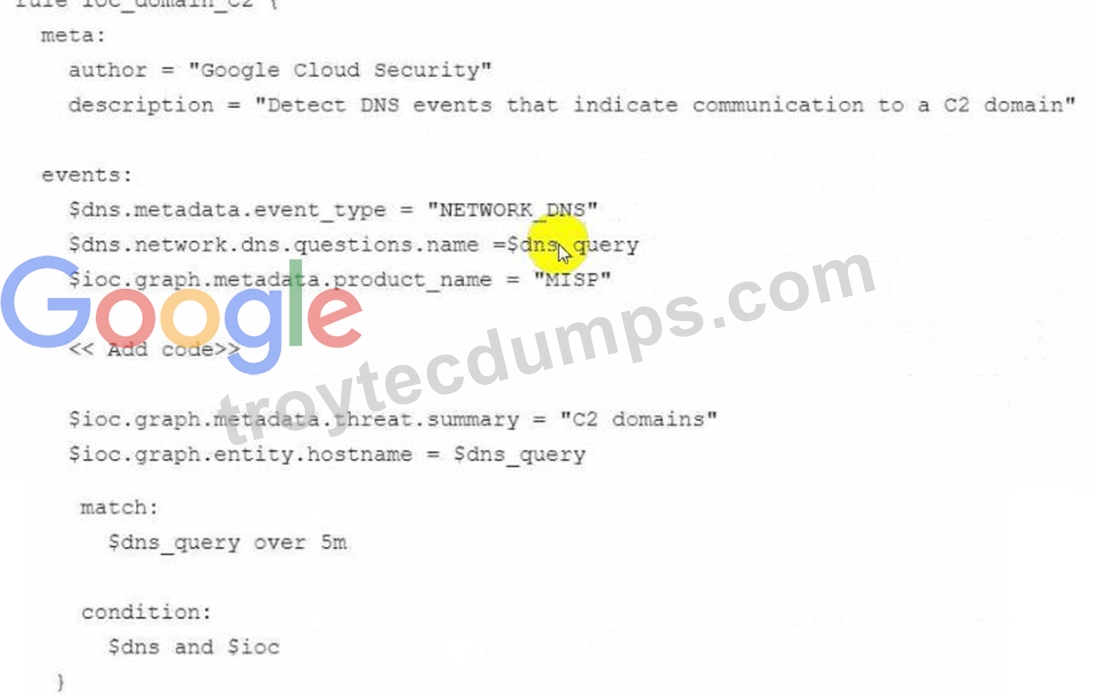
What code should you add in the detection rule to filter for the domain IOCS?
- A. $ioc.graph.metadata.entity_type = "D0MAIN_NAME"
$ioc.graph.metadata.source_type = MDERIVED_CONTEXT" - B. $ioc.graph.metadata.entity_type = "DOMAlN_NAME"
Sioc.graph.metadata.source_type = "GLOBAL_CONTEXT" - C. $ioc.graph.metadata.entity_type = ,'D0MAIN_NAME*'
$ioc.graph.metadata.source type = "source type unspecified" - D. $ioc.graph.metadata.entity_type = MDOMAlN_NAME"
$ioc.graph.metadata.scurce_type = "ElfelTYj^ONTEXT"
Answer: B
Explanation:
This YARA-L rule is designed to correlate a real-time event (a DNS query, $dns) with known-bad indicators stored in the Google SecOps entity graph ($ioc). The code must correctly filter the entity graph to find the specific indicators from the custom MISP feed.
Two filters are required:
* $ioc.graph.metadata.entity_type = "DOMAIN_NAME": This line is essential to filter the entity graph for IoCs that are domains. The rule is trying to match a DNS query ($dns_query) to a known C2 domain, so the entity type must be DOMAIN_NAME.
* $ioc.graph.metadata.source_type = "ENTITY_CONTEXT": This is the key differentiator. The Google SecOps entity graph has multiple context sources. GLOBAL_CONTEXT (Option B) is for threat intelligence provided by Google (e.g., Google Threat Intelligence, Mandiant).
DERIVED_CONTEXT (Option C) is for context inferred from UDM events. The prompt explicitly states the IoC feed is the organization's own "threat intelligence feed... ingested... with... MISP." This type of customer-provided, third-party intelligence is classified as ENTITY_CONTEXT. Adding this line ensures the rule only uses the custom MISP feed for its IoC data, as intended.
The other lines in the $ioc block, such as product_name = "MISP", further refine this ENTITY_CONTEXT search.
(Reference: Google Cloud documentation, "YARA-L 2.0 language syntax"; "Context-aware detections with entity graph"; "Populate the entity graph")
NEW QUESTION # 81
You are responsible for evaluating the level of effort required to integrate a new third-party endpoint detection tool with Google Security Operations (SecOps). Your organization's leadership wants to minimize customization for the new tool for faster deployment. You need to verify that the Google SecOps SOAR and SIEM support the expected workflows for the new third-party tool. You must recommend a tool to your leadership team as quickly as possible. What should you do?
Choose 2 answers
- A. Configure a Pub/Sub topic to ingest raw logs from the third-party tool, and build custom YARA-L rules in Google SecOps to extract relevant security events.
- B. Review the architecture of the tool to identify the cloud provider that hosts the tool.
- C. Identify the tool in the Google SecOps Marketplace, and verify support for the necessary actions in the workflow.
- D. Develop a custom integration that uses Python scripts and Cloud Run functions to forward logs and orchestrate actions between the third-party tool and Google SecOps.
- E. Review the documentation to identify if default parsers exist for the tool, and determine whether the logs are supported and able to be ingested.
Answer: C,E
Explanation:
Comprehensive and Detailed Explanation
The core task is to evaluate a new tool for fast, low-customization deployment across the entire Google SecOps platform (SIEM and SOAR). This requires checking the two main integration points: data ingestion (SIEM) and automated response (SOAR).
* SIEM Ingestion (Option B): To minimize customization for the SIEM, you must verify that Google SecOps can ingest and understand the tool's logs out-of-the-box. This is achieved by checking the Google SecOps documentation for a default parser for that specific tool. If a default parser exists, the logs will be automatically normalized into the Unified Data Model (UDM) upon ingestion, requiring zero custom development.
* SOAR Orchestration (Option C): To minimize customization for SOAR, you must verify that pre- built automated actions exist. The Google SecOps Marketplace contains all pre-built SOAR integrations (connectors). By finding the tool in the Marketplace, you can verify which actions (e.g.,
"Quarantine Host," "Get Process List") are supported, confirming that response playbooks can be built quickly without custom scripting.
Options D and E describe high-effort, custom integration paths, which are the exact opposite of the "minimize customization for faster deployment" requirement.
Exact Extract from Google Security Operations Documents:
Default parsers: Google Security Operations (SecOps) provides a set of default parsers that support many common security products. When logs are ingested from a supported product, SecOps automatically applies the correct parser to normalize the raw log data into the structured Unified Data Model (UDM) format. This is the fastest method to begin ingesting and analyzing new data sources.
Google SecOps Marketplace: The SOAR component of Google SecOps includes a Marketplace that contains a large library of pre-built integrations for common third-party security tools, including EDR, firewalls, and identity providers. Before purchasing a new tool, an engineer should verify its presence in the Marketplace and review the list of supported actions to ensure it meets the organization's automation and orchestration workflow requirements.
References:
Google Cloud Documentation: Google Security Operations > Documentation > Ingestion > Default parsers > Supported default parsers Google Cloud Documentation: Google Security Operations > Documentation > SOAR > Marketplace integrations
NEW QUESTION # 82
Your organization has mission-critical production Compute Engine VMs that you monitor daily. While performing a UDM search in Google Security Operations (SecOps), you discover several outbound network connections from one of the production VMs to an unfamiliar external IP address occurring over the last 48 hours. You need to use Google SecOps to quickly gather more context and assess the reputation of the external IP address. What should you do?
- A. Search for the external IP address in the Alerts & IoCs page in Google SecOps.
- B. Examine the Google SecOps Asset view details for the production VM.
- C. Perform a UDM search to identify the specific user account that was logged into the production VM when the connections occurred.
- D. Create a new detection rule to alert on future traffic from the external IP address.
Answer: A
Explanation:
The most direct and efficient method to "quickly gather more context and assess the reputation" of an unknown IP address is to check it against the platform's integrated threat intelligence. The **Alerts & IoCs page**, specifically the **IoC Matches** tab, is the primary interface for this.
Google Security Operations continuously and automatically correlates all ingested UDM (Universal Data Model) events against its vast, integrated threat intelligence feeds, which include data from Google Threat Intelligence (GTI), Mandiant, and VirusTotal. If the unfamiliar external IP address is a known malicious Indicator of Compromise (IoC)-such as a command-and-control (C2) server, malware distribution point, or known scanner-it will have already generated an "IoC Match" finding.
By searching for the IP on this page, an analyst can immediately confirm if it is on a blocklist and gain critical context, such as its threat category, severity, and the specific intelligence source that flagged it. While Option B (finding the user) and Option C (viewing the asset) are valid subsequent steps for understanding the internal scope of the incident, they do not provide the *external reputation* of the IP. Option D is a *response* action taken only *after* the IP has been assessed as malicious.
*(Reference: Google Cloud documentation, "View alerts and IoCs"; "How Google SecOps automatically matches IoCs"; "Investigate an IP address")*
***
NEW QUESTION # 83
......
Google Security-Operations-Engineer Exam Syllabus Topics:
| Topic | Details |
|---|---|
| Topic 1 |
|
| Topic 2 |
|
| Topic 3 |
|
| Topic 4 |
|
| Topic 5 |
|
Valid Security-Operations-Engineer Exam Dumps Ensure you a HIGH SCORE: https://lead2pass.troytecdumps.com/Security-Operations-Engineer-troytec-exam-dumps.html