

Online CPUX-F Test Brain Dump Question and Test Engine
Real ISQI CPUX-F Exam Dumps with Correct 99 Questions and Answers
ISQI CPUX-F Exam Syllabus Topics:
| Topic | Details |
|---|---|
| Topic 1 |
|
| Topic 2 |
|
| Topic 3 |
|
| Topic 4 |
|
NEW QUESTION 28
Which three of the following deliverables are created during the activity "Produce design solutions to meet user requirements"?
- A. Use scenarios
- B. Evaluation reports
- C. Storyboards
- D. High-fidelity prototypes
- E. User requirements
- F. User experience project plan
Answer: C,E
NEW QUESTION 29
Fill in the blanks;
A user experience professional is a professional who has one or more of the following responsibilities in a project:
1. Planning and managing the____________ design process;
2. Identifying and describing the____________:
3. Deriving the_________ requirements;
4. Creating the___________architecture and the navigation structure;
5. Defining and conceiving the interaction between humans and the interactive system based on the context of_________;use and the
6. Designing the graphic part of the__________;
7. Carrying out___________ of user interfaces in various stages of realisation See answers below.
Answer:
Explanation:
1. human-centred
2. context of use
3. user
4. information
5. user requirements
6. user interface
7. usability evaluations or usability evaluation
A user experience professional is a person who has specific responsibilities associated with the human-centred quality of an interactive system.
Their responsibilities include analysis of the context of use, specifying user requirements, producing design solutions - in particular prototypes - and carrying out usability evaluations.
NEW QUESTION 30
Which one of the following usability findings, on a website that sells train tickets, indicates a problem with satisfaction?
- A. Users liked the modern look of the website
- B. When asked to purchase tickets to Worcester, about 25% of the users gave up because they were unable to spell Worcester correctly and the search for station names was not error tolerant
- C. Only 2 out of 12 users were able to figure out how to obtain a refund for a ticket that they had purchased previously
- D. Users spontaneously said that they considered the animated ads that appear in the right-hand side of most pages annoying
- E. All users were able to purchase return tickets from Oxford to London very quickly
- F. Users with limited vision spent a lot of time reading the tiny fonts used on the website
Answer: D
Explanation:
Explanation
Satisfaction
The extent to which the user's physical, cognitive and emotional responses that result from the use of an interactive system meet the user's needs and expectations.
Notes:
1. Effectiveness and efficiency may influence satisfaction. For example, low effectiveness or low efficiency may lead to low satisfaction. Satisfaction may influence effectiveness and efficiency. For example, frustration may cause users to quit a task, which influences effectiveness.
2. Satisfaction is often measured using a questionnaire. See the examples in the definition of questionnaire.
3. The difference between satisfaction and user experience is that satisfaction results from use, while user experience results from discovering, adopting and using the interactive system, through to final use and recollections of use. In addition, user experience can be influenced by more than just use, for example brand image, price and opinion of others, but it is still related to actual or imagined use.
NEW QUESTION 31
What are usability evaluation methods? Choose two.
- A. A process through which information about the usability of an interactive system is gathered in order to improve the interactive system (known as formative usability evaluation) or to assess the merit or worth of an interactive system (known as summative usability evaluation).
- B. A checklist used by a moderator in a usability test to keep track of briefing and presession interview questions, usability test tasks, and post-session interview questions
- C. Two or more rooms that are specially equipped for usability tests or focus groups.
- D. The purpose of a usability evaluation is to determine whether or not an interactive system, or a prototype of an interactive system, meets the user requirements and applicable dialogue principles, heuristics and user interface guidelines.
Answer: A,D
NEW QUESTION 32
Which one of the following methods is NOT suitable for determining the context of use of a cash machine?
- A. Interview front-line bank clerks
- B. Conduct focus groups regarding user needs for future cash machines
- C. Conduct usability tests with cash machines from competitors
- D. Interview users of a current cash machine
- E. Present the idea of the new cash machine to representative bank customers
- F. Observe users while they are using a current cash machine
Answer: E
NEW QUESTION 33
Which three of the following are dialogue principles?
- A. Suitability for learning
- B. Suitability for the task
- C. Suitability for usability
- D. Accessibility
- E. Conformity with user expectations
- F. Suitability for engagement
Answer: A,B,E
Explanation:
Explanation
Dialogue principles and user interface guidelines are rules, of varying levels of specificity, used to guide the design of the interaction (see section 6). They are intended to make the interaction effective, efficient and satisfying, to avoid common usability problems and to ensure a consistent user interface.
Dialogue principles and heuristics are general guidance for the design of usable dialogues. There are seven dialogue principles; examples of dialogue principles are conformity with user expectations and error tolerance.
Dialogue principles are not bound to any specific technology or method.
The concepts of affordance and mental model supplement the dialogue principles. Affordance is an aspect of an object that makes it obvious how the object could be used. A mental model is the perception people have of themselves and of the things with which they interact.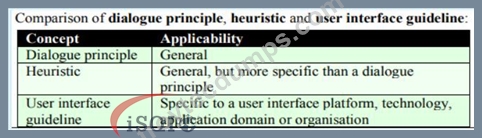
NEW QUESTION 34
What are qualitative user requirements?
- A. Qualitative user requirements address the way in which the system is designed
- B. Qualitative user requirements set measurable goals for usability and user experience.
- C. Qualitative user requirements provide a basis for the design of the interactive system and can be verified by evaluating the interactive system.
- D. Qualitative user requirements address the way in which the interactive system is used to arrive at a user goal
- E. Qualitative user requirements qualify the need for the user requirement in question
- F. Qualitative user requirements set measurable design on quantitative user requirements
Answer: C,D
NEW QUESTION 35
Which two of the following affect the user experience of an airline's website, but not its usability?
- A. The graphics on the website are attractive
- B. After the flight, users are annoyed by unsolicited marketing emails from the airline
- C. Luggage costs are hidden until users have entered their names
- D. Users consider the fares shown on the website to be quite high
- E. It is possible to cancel a ticket and get part of the fare refunded but all users struggled to find out how to get a refund
- F. The airport search is not error tolerant. For example, a search for 'Strassbourg' does not suggest
'Strasbourg'
Answer: B,D
Explanation:
Explanation
Answer A is both user experience and usability/satisfaction Answer D is correct according to the definition of
"satisfaction", example 4. It's also more correct than answer A, B, C and E.
NEW QUESTION 36
What are dialogue principles?
- A. Dialogue principles and heuristics are general guidance for the design of usable programming interfaces
- B. Dialogue principles and heuristics are general guidance for the design of the system architecture.
- C. Dialogue principles and heuristics are general guidance for the design of usable boot technologies.
- D. Dialogue principles and heuristics are general guidance for the design of usable dialogues.
Answer: D
NEW QUESTION 37
If a user's mental model of an interactive system is incomplete or contradictory,
- A. then the user cannot easily use the interactive system.
- B. then the user can still easily use the interactive system.
- C. then the user will have to learn to easily use the interactive system.
Answer: A
NEW QUESTION 38
Which one of the following best describes the purpose of personas?
- A. A persona is a description of a fictitious but realistic user and what they intend to do when using an interactive system
- B. Personas are an efficient way of communicating important information about users gathered during observation and interviews to interested stakeholders
- C. Stakeholders use personas to communicate important information about market requirements and organisational requirements to user experience professionals
- D. Personas are used to recruit usability test participants
- E. Personas are used to gather contextual information relating to user needs without interfering with users' work
- F. Personas are required to generate as-is scenarios, user needs and use scenarios
Answer: A
NEW QUESTION 39
10. Fill in the blank:
A ____________ is a representation of all or part of an interactive system that, although limited in some way, can be used for analysis, design and usability evaluation.
Answer:
Explanation:
1. prototype
NEW QUESTION 40
Usability inspections are carried out by:
- A. Solely by users themselfes
- B. By any participant ready for the task
- C. Solely by user experience professionals
- D. Only by IT-professionals
- E. By those that decided the requirements
- F. By either users or experienced professionals
Answer: C
Explanation:
Explanation
Se side 44 i https://uxqb.org/wp-conten17uploads/documents/CPUX-F_EN_Curriculum-and-Glossary.pdf
NEW QUESTION 41
Which one of the following deliverables are created during the activity "EVALUATE THE DESIGNS AGAINST USER REQUIREMENTS?
- A. User needs
- B. Evaluation reports
- C. User requirements
- D. User journey maps
- E. Style guide
- F. User experience project plan
Answer: B
Explanation:
Explanation
The purpose of a usability evaluation is to determine whether or not an interactive system, or a prototype of an interactive system, meets the user requirements and applicable dialogue principles, heuristics and user interface guidelines. This curriculum addresses three forms of usability evaluation: usability test, usability inspection and user survey. In usability tests and user surveys, users are involved in the usability evaluation, while usability inspections are carried out solely by user experience professionals.
A usability test shows what representative users are able to accomplish with the interactive system when they carry out representative tasks. Eliciting personal opinions from users, or discussing them, is not part of a usability test. The main activities in a usability test are shown in the diagram below: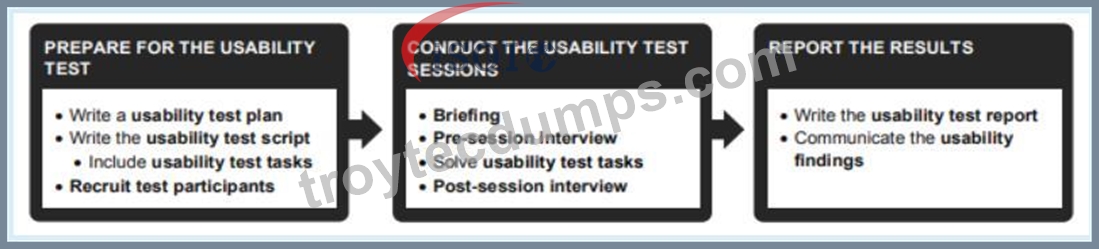
NEW QUESTION 42
Which one of the following must be included in a human-centred design process?
- A. Involvement of users throughout the design process
- B. A clear commitment from management to usability and human-centred design
- C. Regular demonstrations to users of the evolving interactive system
- D. Analysis of competitors' products to understand potential pitfalls
- E. An interest from management in innovation
- F. Exact timelines for usability milestones so progress can be monitored
Answer: A
Explanation:
Explanation
Human-centred design is an approach to design that aims to make interactive systems more usable by focusing on the use of the interactive system and applying usability knowledge and methods. Human-centred design is based upon an explicit understanding of users, goals, tasks, resources and environments. Users are involved throughout the design. The design is driven and refined by usability evaluation. The process is iterative - that is, it continues until the user requirements are met. The design addresses the whole user experience (UX).
Human-centred design means planning for iterations, getting user feedback as early and as often as possible. It is perfectly acceptable to run through the iterations often with lightweight UX deliverables, for example in agile development.
An approach to design that aims to make interactive systems more usable by focusing on the use of the interactive system and applying human factors, ergonomics and usability knowledge and methods. Notes: 1.
The concept "human-centred design" is used instead of "user-centred design" to emphasise the need to consider additional stakeholders who may not be users. 2. Feedback from users through usability evaluation is a critical source of information in human-centred design.
NEW QUESTION 43
What is a contextual interview?
- A. A contextual interview takes place at any other location than the location where the user's interaction with the interactive system usually takes place, for example in a neutral environment, not their home or in a shop.
- B. A contextual interview takes place at the location where the user's interaction with the interactive system usually takes place, for example the user's workplace, their home or in a shop
- C. Establishes focus groups
- D. An contextual interview takes place in a neutral environment, for example in a meeting room.
Answer: B
NEW QUESTION 44
A context of use description describes:
a.______________ in the form of user group profiles and personas;
b.______________ in the form of as-is scenarios;
c.______________ in the form of task models, as-is scenarios or user journey maps;
d.______________ in the form of lists or as-is scenarios;
e. ______________in the form of as-is scenarios.
Answer:
Explanation:
1. Users
2. Goals
3. Tasks
4. Resources
5. Environments
NEW QUESTION 45
8. Gerry works in a bank. One of his responsibilities is to check the amount of cash in the cash machine and reload it to the required level. He does this each morning and on Friday afternoons, in preparation for the weekend. Which one of the following best describes Gerry?
- A. A primary user of the cash machine
- B. A secondary user of the cash machine
- C. A user of the cash machine who is not a stakeholder
- D. An indirect user of the cash machine
- E. A stakeholder in the cash machine who is not a user
- F. Not a user of the cash machine since he does not withdraw money
Answer: F
Explanation:
Explanation
Primary user
A user who uses the interactive system for its intended purpose.
Examples of primary users:
1. A bank customer who uses a cash dispenser to withdraw money is a primary user of the cash dispenser.
2. A call centre operative who uses a reservation system to reserve cars for customers is a primary user of the reservation system.
Secondary user
A user who carries out support tasks with the interactive system, for example to maintain it or to train primary users.
Note: 1.
Secondary users - in particular maintenance staff - typically interact with a different user interface than primary users. This user interface also requires context analysis and specification of user requirements to be usable.
Examples of secondary users:
1. A user who prints a document on a printer is a primary user of the printer. When the same user a moment later changes the ink on the printer, he or she is a secondary user of the printer.
2. A bank employee who restocks a cash dispenser with cash is a secondary user of the cash dispenser.
3. A trainer who teaches a call centre operative how to use a car reservation system is a secondary user of the reservation system.
Indirect user
A user who uses the output of the interactive system, but who does not interact directly with the interactive system.
Examples of indirect users:
1. A bank customer who receives a paper or electronic statement is an indirect user of the bank's computer system.
2. A customer who contacts the call centre to reserve a car is an indirect user of the computer system used by the call centre operative to make the reservation
NEW QUESTION 46
Which one of the following is a valid user requirement for Gamma Airlines website?
- A. If a user books a flight that costs more than £2,000, the website must send a confirmation code to the user's mobile phone; the reservation must not be accepted before the user has entered the correct confirmation code on the website
- B. Users must be able to select the payment methods they used for previous reservations
- C. Gamma Airlines website must be at least as efficient as the websites of the two most important competitors, Alpha Airlines and Beta Airlines
- D. Users must be able to book a flight within a reasonable time
- E. Gamma Airlines website must be effective, efficient and satisfactory to use
- F. Most users who frequently book flights on Gamma Airlines website must be satisfied with the website
Answer: B
Explanation:
Explanation
A requirement for use that provides the basis for design and evaluation of an interactive system to meet identified user needs.
Notes:
1. User requirements are derived from user needs.
2. A user requirement can be a qualitative user requirement or a quantitative user requirement.
3. Both qualitative and quantitative user requirements provide a basis for the design of the interactive system and can be verified by evaluating the interactive system. While qualitative user requirements address the way in which the interactive system is used to arrive at a user goal, quantitative user requirements set measurable goals for usability and user experience.
NEW QUESTION 47
Choose all that apply - Interview questions should be:
- A. Strictly on topic rather then off topic
- B. Open rather than closed
- C. Aming for simple yes or no
- D. Neutral rather than leading
- E. Entertaining
- F. Open minded for alternative cultural aspects
Answer: B,D
NEW QUESTION 48
Which two of the following statements about user needs are correct?
- A. User needs for a user group may differ from user needs for another user group with the same context of use
- B. User needs are part of the information architecture
- C. User needs are always expressed from the user's point of view
- D. User needs are always quantified
- E. User needs are identical to user goals
- F. User needs are used to write good error messages
Answer: A
Explanation:
Explanation
The context of use is described in user group profiles and personas (who are the users), as-is scenarios (how do users currently do tasks), task models (details about what the tasks are) and user journey maps (how users interact with the interactive system and the organisation providing it).
A user group profile is a generalised description of a collection of users with the same or similar personal characteristics and context of use related to the interactive system.
A persona is a description of a fictitious but realistic user and what he or she intends to do when using the interactive system.
An as-is scenario is a narrative text description of the procedure a specific user currently follows to complete one or more tasks, A task model is a list of subtasks for each task which the user has to complete to reach their goals. Task models help the design team to design the right solution for each task. User journey maps provide an overview of the touchpoints where users interact with the interactive system and the organisation providing the interactive system. They help stakeholders and user experience professionals understand and optimise the user experience.
The main purpose of personas and as-is scenarios is to identify user needs and make it easier for designers, developers and other stakeholders to understand who the users are, what they do, what their obstacles are, and to facilitate discussions within the design team.
NEW QUESTION 49
......
Valid CPUX-F Test Answers & ISQI CPUX-F Exam PDF: https://lead2pass.troytecdumps.com/CPUX-F-troytec-exam-dumps.html