

Latest Jul-2023 QSDA2022 Dumps PDF And Certification Training
Check your preparation for Qlik QSDA2022 On-Demand Exam
The Qlik QSDA2022 certification exam covers a wide range of topics related to Qlik Sense data architecture. Some of the topics covered in the exam include data modeling, data integration, data transformation, data governance, and data security. The exam also covers Qlik Sense features such as Qlik Sense Desktop, Qlik Sense Enterprise, and Qlik Sense Cloud.
The QSDA2022 exam consists of 50 multiple-choice questions and has a time limit of 2 hours. The exam is conducted online and can be taken from anywhere in the world. Candidates who successfully pass the exam will receive a digital certificate and a badge that can be displayed on their LinkedIn profiles.
NEW QUESTION # 37
A company needs to analyze sales data based on the exchange rate of the different countries every day About
30 reports must be produced with an average of 20r000 rows each. This process is estimated to take about three hours.
Reports will be in Excel and distributed to business users according to defined security rules Which two products should the data architect use to build this solution? (Select two.)
- A. QIikDataMarket
- B. OQIikGeoAnalytics
- C. QIik NPrinting
- D. ODAG
- E. Qlik Storytelling
Answer: C,D
Explanation:
Explanation
The best answer choices are B.
ODAG and E. QIik NPrinting.
ODAG (On Demand Application Generation) is a product from Qlik that can be used to quickly generate reports from large datasets.
It can produce reports with up to 20,000 rows and can do so in less than three hours.
NPrinting is a product from Qlik that can be used to distribute the reports in Excel format according to the defined security rules.
NEW QUESTION # 38
Refer to the exhibit.
A data architect builds a simple data model to show the relationship between students and exams. The data is loaded. Every StudentID in the Exams table should be found in the Students table. Some students have NOT taken an exam.
The data architect selects the field "StudentID" from the Students table and sees the following:
A data architect needs to fix this anomaly.
What should the data architect do to ensure data integrity?
- A. In the LOAD script, add DISTINCT before the Students and Exams tables
- B. Update the Exams table and add 33.4% of the missing records
- C. Remove records from the Exams table where StudentID is null
- D. Update the Students table and add 16.7% of the missing records
Answer: A
NEW QUESTION # 39
A data architect needs to build an Order Fulfillment app. The business requires front-end performance is optimized.
The OrderDate and ShipmentDate are located in different tables.
The user needs to identify thedata type and must be able to:
* Show trends for orders and shipments
* Use a single filter for both date fields
* Analyze data over fiscal periods
Which steps should the data architect take to build the data model?
- A. 1. Create a master calendar table as a data island
2. Create a single filter using fields from the master calendar - B. 1. Load the Shipments and Orders table via the data manager
2. Create a single filter using fields from the Orders table - C. 1. Create a link table with master calendar fields
2. Create a single filter using fields from the master calendar - D. 1. Create a master calendar andjoin into the Shipments and Orders table
2. Create a single filter using fields from the Shipments table
Answer: C
NEW QUESTION # 40
Refer to the exhibit.
A data architect is working with an app and creates some visualizations to check the data. Some visualizations showissues in the data set.
* The Sales by Country table shows a total OrderValue of 18,300 sales while the KPI shows a total OrderValue of 20,600.
* The Sales monthly trend bar chart does not work with the Month field.
Which two data issues should the data architect fix in the app? (Select two.)
- A. In the Orders table, some values in the CustomerlD field do not exist in the Customers table.
- B. The OrderDate field values in the Calendar table do not match with the values in the OrderDate field from the Orders table
- C. The Month field does not exist in the Orders table and needs to be incorporated in the table using he Calendar table.
- D. In the Orders table, some CustomerlD values are null because there are orders with no customer.
and needs to be incorporated in the table using the Calendar table, null because there are orders with no customer
Answer: A,B
NEW QUESTION # 41
Refer to the exhibit.
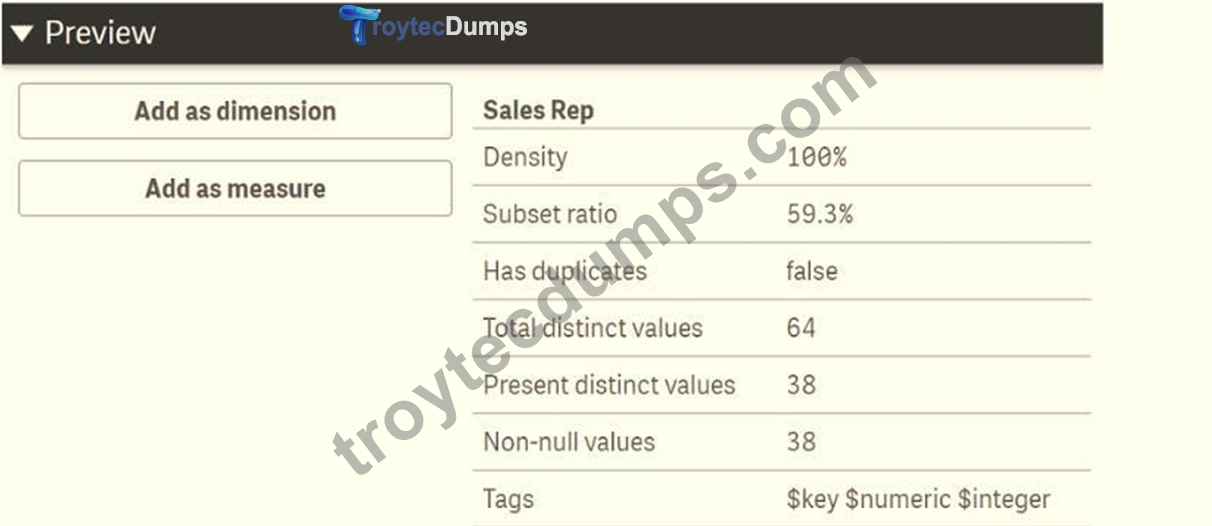
Refer to the exhibits.
While using an app, the users report that some Sales Reps do NOT have personal details, like Division or Address Number A data architect has been called in to investigate.
The data architect uses the data model viewer to determine the relationship between the SalesRepMaster and CustomerMaster tables.
What is the cause of the issue?
- A. 59.3% of the Sales Rep have CustomerMaster information
- B. 40.7% of the Sales Rep have CustomerMaster information
- C. 26 values for Sales Rep are null in CustomerMaster
- D. Density is 100% while Total Distinct and Present Distinct are NOT the same
Answer: D
Explanation:
Explanation
When using the data model viewer to investigate the relationship between the SalesRepMaster and CustomerMaster tables, the data architect would look at the density of the relationship. Density is a measure of how well the key fields of a table match the key fields of another table. A density of 100% means that all key fields in one table have a match in the other table.
When the density is 100% but the total distinct and present distinct values for the key fields of the related tables do not match, it means that some of the key fields in one table do not have a match in the other table, this is the cause of the issue.
NEW QUESTION # 42
Refer to the exhibit.
A data architect loads sales data and creates a table which shows only customers who made purchases in 2018 and 2019. The data architect applies the following set analysis expression on the sales measure.
Count<{<Year={'2 018'}, CustomerID=P({<Year={'2019*}>})>} Customer ID)
Which option shows the resulting table after the expression is applied?
A)
B)
C)
D)
- A. Option A
- B. Option D
- C. Option C
- D. Option B
Answer: B
NEW QUESTION # 43
A data architect is building a model to show trends in visualizations across seven date fields. The seven date fields reside in different tables. The data architect must efficiently build this data model.
Requirements:
* A single date selector
* Show all dates, even those with NO activity
* Minimize the impact on server resources and p
Which two solutions should the data architect use? (Select two.)
- A. Link table
- B. Data island
- C. Generic load
- D. Canonical calendar
- E. Multiple calendars
Answer: A,D
Explanation:
Explanation
A canonical calendar should be used to create a single date selector that can be used to show all dates, even those with no activity. A link table should be used to join the seven date fields from different tables, which willminimize the impact on server resources and performance.Source: Qlik
NEW QUESTION # 44 
A company has different departments.
Executive and Sales should always be the first values in a Department filter pane.
Which script must the data architect use to meet this requirement?
- A.

- B.

- C.

- D.

Answer: B
NEW QUESTION # 45 
On executing a load script of an app, the country field needs to be normalized. The developer uses a mapping table to address the issue.
What should the data architect do?
- A. Review the values of the source mapping table
- B. Create two different mapping tables
- C. Use a LEFT JOIN instead of the APPLYMAP
- D. Use LOAD DISTINCT on the mapping table
Answer: A
NEW QUESTION # 46
A data architect needs to revise an existing app.
The number of data rows has grown rapidly recently. While the app is in production, users are becoming increasingly unhappy about the response times when they make selections Which two methods should be used toimprove performance? (Select two.)
- A. Use flags in the data model to simplify set analysis
- B. Create master items for all complex expressions
- C. Use dynamic script generation with variables
- D. Make sure any Ul variables are preceded by '='
- E. Denormalize the schema
Answer: A,C
NEW QUESTION # 47
A data architect builds a data model for a large user group. Some sheets will be published, and the app will allow users to create their own visualizations and analyze data. Some fields must NOT appear in any field list.
How should a data architect meet these requirements?
- A. Use HideField variable
- B. Add fields to master items
- C. Use security rules
- D. Use HidePrefix variable
Answer: C
Explanation:
Explanation
The best way for a data architect to meet the requirements of not allowing some fields to appear in any field list is to use security rules. Security rules can be used to restrict access to certain fields, which will ensure that they don't appear in any field list or visualization. Additionally, security rules can also be used to restrict access to certain data models, ensuring that only users with the right permissions can view and analyze the data.
Row-level security (RLS) with Power BI - Power BI | Microsoft Learn
https://learn.microsoft.com/en-us/power-bi/enterprise/service-admin-rls What Is Data Visualization? Definition & Examples | Tableau
https://www.tableau.com/learn/articles/data-visualization
80+ Top Power BI Interview Questions and Answers [Updated 2023]
https://www.edureka.co/blog/interview-questions/power-bi-interview-questions/
NEW QUESTION # 48
Refer to the exhibit.
What are the values of the variables vLoadStart and vLoadComplete after the script executes?
- A. vLoadStart: system date when the app was opened vLoadComplete: current system date and time when the script ended
- B. vLoadStart: system date when the app was opened vLoadComplete 'now()'
- C. vLoadStart: current system date and time when the script started vLoadComplete: 'now()'
- D. vLoadStart; 'NOW{)'
vLoadComplete: current system date and time when the script ended
Answer: C
Explanation:
Explanation
vLoadStart variable is assigned the current system date and time when the script starts, and vLoadComplete variable is assigned the current system date and time when the script ends.
NEW QUESTION # 49
Refer to the exhibit.
A business department is forecasting revenue within an Excel spreadsheet.
A data architect needs to include this forecast into the existing data model, and without losing any data.
Which two sets of steps will meet these requirements? (Select two.)
- A. 1. Load the Excel spreadsheet using the data load editor
2. Use the Unpivot function
3 Use the Sum function to group the forecast by date
4 Connect to the existing data model - B. 1 Load the Excel spreadsheet into the data manager
2. Use the Unpivot function
3. Create a composite key from the date and region
4. Connect the new table to the data model
1 Load the Excel spreadsheet using the data manager
2 Rename the ForecastDate field to Date 3. Disable the Region
4 Connect to the existing data model - C. 1 Load the Excel spreadsheet using the data load editor
2. Change the sort order by date
3. Create a composite key out of the forecast and region 4 Connect to the existing data model - D. 1. Load the Excel spreadsheet using the data load editor
2 Use the Crosstable function to unpivot the table
3 Create a composite key out of the date and region
4 Connect the new table to the data model
Answer: B,D
Explanation:
Explanation
Option B involves loading the Excel spreadsheet using the data load editor and then using the Crosstable function to unpivot the table, creating a composite key out of the date and region, and connecting the new table to the existing data model. Option D involves loading the Excel spreadsheet using the data manager, using the Unpivot function, creating a composite key from the date and region, and connecting the new table to the existing data model.
NEW QUESTION # 50
A data architect needs to develop a script to export tables from a model based upon rules from an independent file. Thestructure of the text file with the export rules is as follows:
These rules govern which table in the model to export, what the target root filename should be, and the number of copies to export.
The TableToExport values are already verified to existin the model.
In addition, the format will always be QVD, and the copies will be incrementally numbered.
For example, the Customer table would be exported as:
What is the minimum set of scripting strategies the data architect must use?
- A. One loop and two IF statements
- B. One loop and one SELECT CASE statement
- C. Two loopswithout any conditional statement
- D. Two loops and one IF statement
Answer: B
Explanation:
Explanation
The data architect will need to use a single loop to iterate through the rows of the independent filecontaining the export rules. Within the loop, they will need to use a SELECT CASE statement to determine which table in the model to export based on the TableToExport value in the current row of the independent file. They can then use the StoreAsFilenamevalue to determine the target root filename, and the NumberOfCopies value to determine the number of copies to export.
This approach makes use of a single loop to iterate through the rows of the independent file, and a SELECT CASE statement to determine which table to export based on the TableToExport value in the current row. It is the most efficient way to accomplish the task with minimal scripting.
You can find the Qlik scripting documentation for Store statement
here:https://help.qlik.com/en-US/sense/June2020/Subsystems/Hub/Content/Scripting/ScriptPrefixes/Store.htman SELECT CASE statement here:https://help.qlik.com/en-US/sense/June2020/Subsystems/Hub/Content/Scripting/ScriptStatements/Select.htm
NEW QUESTION # 51
A data architect executes the following script:
Whatwill be the result of Table A?
A)
B)
C)
D)
- A. Option A
- B. Option D
- C. Option C
- D. Option B
Answer: B
NEW QUESTION # 52
A company decides to migrate all apps from QlikView to Qlik Sense. After converting an apps: there are several unconverted objects What should the data architect do?
- A. Save the unconverted objects as extensions and import them into Qlik Sense
- B. Re-create the unconverted objects
- C. Save the unconverted objects as master items
- D. Remove the set analysis statements from the unconverted objects
Answer: B
Explanation:
Explanation
After migrating an app from QlikView to Qlik Sense, there may be some unconverted objects. In this case, the data architect should re-create the unconverted objects in order to ensure that the app works properly in Qlik Sense. The other options will not work, as saving the unconverted objects as extensions or master items will not ensure that the app works properly, and removing set analysis statements will not help either.
qlik-sense-certification-exam-study-guide-en.pdf
https://www.qlik.com/us/-/media/files/training/global-us/qlik-sense-certification-exam-study-guide-en.pdf?la=en Talk to Experts Tuesday - Migrating from QlikView to Qlik Sense FAQ
https://community.qlik.com/t5/Support-Knowledge-Base/Talk-to-Experts-Tuesday-Migrating-from-QlikView-to Certifications & Qualifications | Qlik
https://www.qlik.com/us/services/training/certifications-and-qualifications
NEW QUESTION # 53
Refer to the exhibit.
A business analyst reports that the 'CompanyAge' field does NOT display for users The data architect examines the LOAD script and wants to place the breakpoint in the script to check the field name.
Which line number should the data architect use?
- A. 251 because the field name appears in the Output panel of the debugger
- B. 242 because field name appears in the output Panel of the debugger
- C. 251 because the field name appears in the Variable panel of the debugger
- D. 251 because the field name appears in the Qlik Log files
Answer: A
NEW QUESTION # 54
A data architect needs to create an app that combines employee data from the Sales system and the Human Resources (HR) system.
These systems identify employees differently Employees in the HR system are identified with an alpha-numeric key Employees in the Sales system are identified using an integer key.
The Human Resources manager creates a table that maps these keys to another, called Associations.
The resultant data model must meet the following requirements:
* Associations must be valid
* The model must be optimized for performance
* The option must support multiple tables added
Which solution should the data architect use to meet these requirements?
- A. MAP EmloyeeKey USING Associations;
- B. MAPSUBSTRING ( 'Associations' ,EMployeekey) As Employeekey;
- C. RENAME FIELDS USING Associations;
- D. APPLYMAP ( 'Associations , EmployeeKey ) as Employeekey;
Answer: A
Explanation:
Explanation
The MAP function maps the EmployeeKey in the Sales system to the EmployeeKey in the HR system using the Associations table. This allows the data architect to join the data from the Sales system and the HR system using the same key, ensuring that the associations are valid.
Using the MAP function also optimizes the performance of the data model as it eliminates the need for multiple joins between the data from the Sales and HR systems.
This solution also supports multiple tables added, as the MAP function can be applied to any table that needs to be joined with the HR system data.
NEW QUESTION # 55
A data architect wants to combine data on present and historic sales performance.
The historic data is stored in a de-normalized archive, and the present data is maintained in a database.
The output must be contained in a single table.
Which script should the data architect use?
- A.

- B.

- C.

- D.

Answer: A
NEW QUESTION # 56
Refer to the exhibit.
The data architect needs to build a model that contains Sales and Budget data for each customer.
Some customers have Sales without a Budget, and other customers have a Budget with no Sales During loading, the data architect resolves a synthetic key by creating the composite key For validation, the data architect creates a table containing Customer, Month. Sales, and Budget columns.
What does the data architect see when selecting a month?
- A. Customer and Budget records for that month, but missing values for Sales
- B. All Customers, all Budget and all Sales records
- C. Customer and Sales records for that month, but missing values for Budget
- D. Customer, Sales, and Budget records for that month
Answer: D
NEW QUESTION # 57
Refer to the exhibit.
An existing app on Qlik Sense Enterprise is duplicated and transferred to a data architect to add some additional data When trying to manually reload the original script, the data architect receives an error What should be done to make sure the script runs correctly?
- A. Give the data architect the Read rights on the data connections in the QMC
- B. Add the line lib connect to 'QVD(abc_qservice/orderData.qvd) '; before the LOAD for the Order Data table
- C. Add the line lib connect to ' SQL (abc_qs9rvi.es) ' ;before the LOAD for the Order Detail table
- D. Make the data architect the owner of the app in the QMC
Answer: A
NEW QUESTION # 58
Refer to the exhibit.
A customer needs to load forecast data from an Excel file.
Which preceding load statement should the data architect use to load the data?
- A.

- B.

- C.

- D.

Answer: A
NEW QUESTION # 59
......
Valid QSDA2022 Dumps for Helping Passing Qlik Exam: https://lead2pass.troytecdumps.com/QSDA2022-troytec-exam-dumps.html