

Guide (New 2024) Actual Microsoft DP-203 Exam Questions
DP-203 Exam Dumps Pass with Updated 2024 Certified Exam Questions
NEW QUESTION # 54
You have a SQL pool in Azure Synapse.
You plan to load data from Azure Blob storage to a staging table. Approximately 1 million rows of data will be loaded daily. The table will be truncated before each daily load.
You need to create the staging table. The solution must minimize how long it takes to load the data to the staging table.
How should you configure the table? To answer, select the appropriate options in the answer area.
NOTE: Each correct selection is worth one point.
Answer:
Explanation:
Reference:
https://docs.microsoft.com/en-us/azure/synapse-analytics/sql-data-warehouse/sql-data-warehouse-tables-partition
https://docs.microsoft.com/en-us/azure/synapse-analytics/sql-data-warehouse/sql-data-warehouse-tables-distribute
NEW QUESTION # 55
You have an enterprise-wide Azure Data Lake Storage Gen2 account. The data lake is accessible only through an Azure virtual network named VNET1.
You are building a SQL pool in Azure Synapse that will use data from the data lake.
Your company has a sales team. All the members of the sales team are in an Azure Active Directory group named Sales. POSIX controls are used to assign the Sales group access to the files in the data lake.
You plan to load data to the SQL pool every hour.
You need to ensure that the SQL pool can load the sales data from the data lake.
Which three actions should you perform? Each correct answer presents part of the solution.
NOTE: Each area selection is worth one point.
- A. Use the managed identity as the credentials for the data load process.
- B. Use the snared access signature (SAS) as the credentials for the data load process.
- C. Create a shared access signature (SAS).
- D. Add your Azure Active Directory (Azure AD) account to the Sales group.
- E. Create a managed identity.
- F. Add the managed identity to the Sales group.
Answer: D,E,F
Explanation:
The managed identity grants permissions to the dedicated SQL pools in the workspace.
Note: Managed identity for Azure resources is a feature of Azure Active Directory. The feature provides Azure services with an automatically managed identity in Azure AD Reference:
https://docs.microsoft.com/en-us/azure/synapse-analytics/security/synapse-workspace-managed-identity Design and develop data processing Question Set 1
NEW QUESTION # 56
You have an Azure subscription.
You plan to build a data warehouse in an Azure Synapse Analytics dedicated SQL pool named pool1 that will contain staging tables and a dimensional model Pool1 will contain the following tables.

Answer:
Explanation:
NEW QUESTION # 57
You have an Azure Data Factory instance that contains two pipelines named Pipeline1 and Pipeline2.
Pipeline1 has the activities shown in the following exhibit.
Pipeline2 has the activities shown in the following exhibit.
You execute Pipeline2, and Stored procedure1 in Pipeline1 fails.
What is the status of the pipeline runs?
- A. Pipeline1 and Pipeline2 succeeded.
- B. Pipeline1 and Pipeline2 failed.
- C. Pipeline1 failed and Pipeline2 succeeded.
- D. Pipeline1 succeeded and Pipeline2 failed.
Answer: A
Explanation:
Explanation
Activities are linked together via dependencies. A dependency has a condition of one of the following:
Succeeded, Failed, Skipped, or Completed.
Consider Pipeline1:
If we have a pipeline with two activities where Activity2 has a failure dependency on Activity1, the pipeline will not fail just because Activity1 failed. If Activity1 fails and Activity2 succeeds, the pipeline will succeed.
This scenario is treated as a try-catch block by Data Factory.
Waterfall chart Description automatically generated with medium confidence
The failure dependency means this pipeline reports success.
Note:
If we have a pipeline containing Activity1 and Activity2, and Activity2 has a success dependency on Activity1, it will only execute if Activity1 is successful. In this scenario, if Activity1 fails, the pipeline will fail.
Reference:
https://datasavvy.me/category/azure-data-factory/
NEW QUESTION # 58
You are batch loading a table in an Azure Synapse Analytics dedicated SQL pool.
You need to load data from a staging table to the target table. The solution must ensure that if an error occurs while loading the data to the target table, all the inserts in that batch are undone.
How should you complete the Transact-SQL code? To answer, drag the appropriate values to the correct targets. Each value may be used once, more than once, or not at all. You may need to drag the split bar between panes or scroll to view content.
NOTE Each correct selection is worth one point.
Answer:
Explanation:
NEW QUESTION # 59
You have an Azure Synapse Analytics dedicated SQL pool that contains the users shown in the following table.
User1 executes a query on the database, and the query returns the results shown in the following exhibit.
User1 is the only user who has access to the unmasked data.
Use the drop-down menus to select the answer choice that completes each statement based on the information presented in the graphic.
NOTE: Each correct selection is worth one point.
Answer:
Explanation:
Reference:
https://docs.microsoft.com/en-us/azure/azure-sql/database/dynamic-data-masking-overview
NEW QUESTION # 60
You have a Microsoft SQL Server database that uses a third normal form schema.
You plan to migrate the data in the database to a star schema in an Azure Synapse Analytics dedicated SQI pool.
You need to design the dimension tables. The solution must optimize read operations.
What should you include in the solution? to answer, select the appropriate options in the answer area.
NOTE: Each correct selection is worth one point.
Answer:
Explanation:
Reference:
https://www.mssqltips.com/sqlservertip/5614/explore-the-role-of-normal-forms-in-dimensional-modeling/
https://docs.microsoft.com/en-us/azure/synapse-analytics/sql-data-warehouse/sql-data-warehouse-tables-identity
NEW QUESTION # 61
You develop data engineering solutions for a company.
A project requires the deployment of data to Azure Data Lake Storage.
You need to implement role-based access control (RBAC) so that project members can manage the Azure Data Lake Storage resources.
Which three actions should you perform? Each correct answer presents part of the solution.
NOTE: Each correct selection is worth one point.
- A. Configure end-user authentication for the Azure Data Lake Storage account.
- B. Configure service-to-service authentication for the Azure Data Lake Storage account.
- C. Assign Azure AD security groups to Azure Data Lake Storage.
- D. Configure access control lists (ACL) for the Azure Data Lake Storage account.
- E. Create security groups in Azure Active Directory (Azure AD) and add project members.
Answer: C,D,E
Explanation:
Explanation
References:
https://docs.microsoft.com/en-us/azure/data-lake-store/data-lake-store-secure-data
NEW QUESTION # 62
You are designing a date dimension table in an Azure Synapse Analytics dedicated SQL pool. The date dimension table will be used by all the fact tables.
Which distribution type should you recommend to minimize data movement?
- A. ROUND ROBIN
- B. REPLICATE
- C. HASH
Answer: B
Explanation:
A replicated table has a full copy of the table available on every Compute node. Queries run fast on replicated tables since joins on replicated tables don't require data movement. Replication requires extra storage, though, and isn't practical for large tables.
Reference:
https://docs.microsoft.com/en-us/azure/synapse-analytics/sql-data-warehouse/sql-data-warehouse-tables-overview
NEW QUESTION # 63
You have an Azure Synapse Analytics dedicated SQL pool named pool1.
You plan to implement a star schema in pool1 and create a new table named DimCustomer by using the following code.
You need to ensure that DimCustomer has the necessary columns to support a Type 2 slowly changing dimension (SCD). Which two columns should you add? Each correct answer presents part of the solution.
NOTE: Each correct selection is worth one point.
- A. [EffectiveEndDate] [datetime] NOT NULL
- B. [PreviousModifiedDate] [datetime] NOT NULL
- C. [HistoricalSalesPerson] [nvarchar] (256) NOT NULL
- D. [EffectiveStartDate] [datetime] NOT NULL
- E. [RowID] [bigint] NOT NULL
Answer: A,C
NEW QUESTION # 64
You are designing a real-time dashboard solution that will visualize streaming data from remote sensors that connect to the internet. The streaming data must be aggregated to show the average value of each 10-second interval. The data will be discarded after being displayed in the dashboard.
The solution will use Azure Stream Analytics and must meet the following requirements:
* Minimize latency from an Azure Event hub to the dashboard.
* Minimize the required storage.
* Minimize development effort.
What should you include in the solution? To answer, select the appropriate options in the answer area.
NOTE: Each correct selection is worth one point
Answer:
Explanation:
Explanation
Reference:
https://docs.microsoft.com/en-us/azure/stream-analytics/stream-analytics-power-bi-dashboard
NEW QUESTION # 65
You have an Azure Data Factory instance named ADF1 and two Azure Synapse Analytics workspaces named WS1 and WS2.
ADF1 contains the following pipelines:
P1: Uses a copy activity to copy data from a nonpartitioned table in a dedicated SQL pool of WS1 to an Azure Data Lake Storage Gen2 account P2: Uses a copy activity to copy data from text-delimited files in an Azure Data Lake Storage Gen2 account to a nonpartitioned table in a dedicated SQL pool of WS2 You need to configure P1 and P2 to maximize parallelism and performance.
Which dataset settings should you configure for the copy activity if each pipeline? To answer, select the appropriate options in the answer are a.
NOTE: Each correct selection is worth one point.
Answer:
Explanation:
Reference:
https://docs.microsoft.com/en-us/azure/synapse-analytics/sql/load-data-overview
NEW QUESTION # 66
A company has a real-time data analysis solution that is hosted on Microsoft Azure. The solution uses Azure Event Hub to ingest data and an Azure Stream Analytics cloud job to analyze the dat a. The cloud job is configured to use 120 Streaming Units (SU).
You need to optimize performance for the Azure Stream Analytics job.
Which two actions should you perform? Each correct answer presents part of the solution.
NOTE: Each correct selection is worth one point.
- A. Implement Azure Stream Analytics user-defined functions (UDF).
- B. Implement event ordering.
- C. Implement query parallelization by partitioning the data output.
- D. Scale the SU count for the job down.
- E. Implement query parallelization by partitioning the data input.
- F. Scale the SU count for the job up.
Answer: E,F
Explanation:
Reference:
https://docs.microsoft.com/en-us/azure/stream-analytics/stream-analytics-parallelization
NEW QUESTION # 67
You have an Azure subscription that contains an Azure Data Lake Storage account. The storage account contains a data lake named DataLake1.
You plan to use an Azure data factory to ingest data from a folder in DataLake1, transform the data, and land the data in another folder.
You need to ensure that the data factory can read and write data from any folder in the DataLake1 file system.
The solution must meet the following requirements:
* Minimize the risk of unauthorized user access.
* Use the principle of least privilege.
* Minimize maintenance effort.
How should you configure access to the storage account for the data factory? To answer, select the appropriate options in the answer area.
NOTE: Each correct selection is worth one point.
Answer:
Explanation:
Explanation
Text Description automatically generated with low confidence
Box 1: Azure Active Directory (Azure AD)
On Azure, managed identities eliminate the need for developers having to manage credentials by providing an identity for the Azure resource in Azure AD and using it to obtain Azure Active Directory (Azure AD) tokens.
Box 2: a managed identity
A data factory can be associated with a managed identity for Azure resources, which represents this specific data factory. You can directly use this managed identity for Data Lake Storage Gen2 authentication, similar to using your own service principal. It allows this designated factory to access and copy data to or from your Data Lake Storage Gen2.
Note: The Azure Data Lake Storage Gen2 connector supports the following authentication types.
* Account key authentication
* Service principal authentication
* Managed identities for Azure resources authentication
Reference:
https://docs.microsoft.com/en-us/azure/active-directory/managed-identities-azure-resources/overview
https://docs.microsoft.com/en-us/azure/data-factory/connector-azure-data-lake-storage
NEW QUESTION # 68
You are developing an Azure Synapse Analytics pipeline that will include a mapping data flow named Dataflow1. Dataflow1 will read customer data from an external source and use a Type 1 slowly changing dimension (SCO) when loading the data into a table named DimCustomer1 in an Azure Synapse Analytics dedicated SQL pool.
You need to ensure that Dataflow1 can perform the following tasks:
* Detect whether the data of a given customer has changed in the DimCustomer table.
* Perform an upsert to the DimCustomer table.
Which type of transformation should you use for each task? To answer, select the appropriate options in the answer area NOTE; Each correct selection is worth one point.
Answer:
Explanation:
Explanation
NEW QUESTION # 69
You are designing a monitoring solution for a fleet of 500 vehicles. Each vehicle has a GPS tracking device that sends data to an Azure event hub once per minute.
You have a CSV file in an Azure Data Lake Storage Gen2 container. The file maintains the expected geographical area in which each vehicle should be.
You need to ensure that when a GPS position is outside the expected area, a message is added to another event hub for processing within 30 seconds. The solution must minimize cost.
What should you include in the solution? To answer, select the appropriate options in the answer area.
NOTE: Each correct selection is worth one point.
Answer:
Explanation:
Explanation
Box 1: Azure Stream Analytics
Box 2: Hopping
Hopping window functions hop forward in time by a fixed period. It may be easy to think of them as Tumbling windows that can overlap and be emitted more often than the window size. Events can belong to more than one Hopping window result set. To make a Hopping window the same as a Tumbling window, specify the hop size to be the same as the window size.
Box 3: Point within polygon
Reference:
https://docs.microsoft.com/en-us/azure/stream-analytics/stream-analytics-window-functions
NEW QUESTION # 70
You develop a dataset named DBTBL1 by using Azure Databricks.
DBTBL1 contains the following columns:
* SensorTypeID
* GeographyRegionID
* Year
* Month
* Day
* Hour
* Minute
* Temperature
* WindSpeed
* Other
You need to store the data to support daily incremental load pipelines that vary for each GeographyRegionID.
The solution must minimize storage costs.
How should you complete the code? To answer, select the appropriate options in the answer area.
NOTE: Each correct selection is worth one point.
Answer:
Explanation:
Explanation
Graphical user interface, text, application Description automatically generated
NEW QUESTION # 71
You have an Azure event hub named retailhub that has 16 partitions. Transactions are posted to retailhub. Each transaction includes the transaction ID, the individual line items, and the payment details. The transaction ID is used as the partition key.
You are designing an Azure Stream Analytics job to identify potentially fraudulent transactions at a retail store. The job will use retailhub as the input. The job will output the transaction ID, the individual line items, the payment details, a fraud score, and a fraud indicator.
You plan to send the output to an Azure event hub named fraudhub.
You need to ensure that the fraud detection solution is highly scalable and processes transactions as quickly as possible.
How should you structure the output of the Stream Analytics job? To answer, select the appropriate options in the answer area.
NOTE: Each correct selection is worth one point.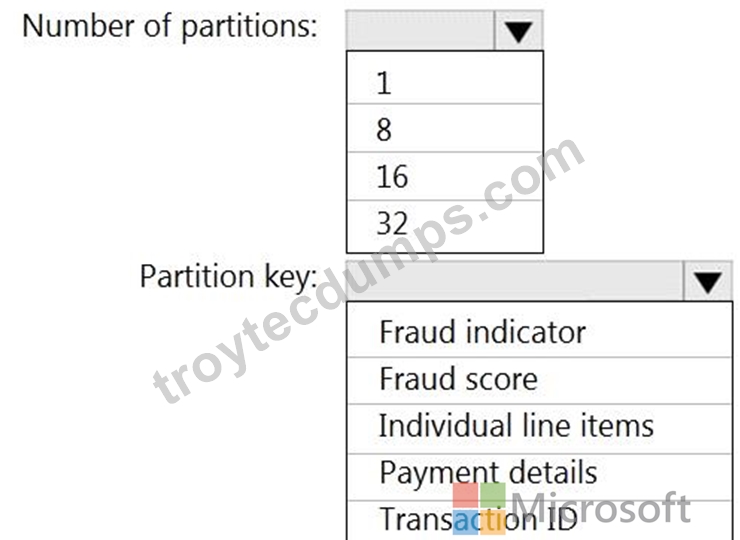
Answer:
Explanation:
Reference:
https://docs.microsoft.com/en-us/azure/event-hubs/event-hubs-features#partitions
NEW QUESTION # 72
You need to create a partitioned table in an Azure Synapse Analytics dedicated SQL pool.
How should you complete the Transact-SQL statement? To answer, drag the appropriate values to the correct targets. Each value may be used once, more than once, or not at all. You may need to drag the split bar between panes or scroll to view content.
NOTE: Each correct selection is worth one point.
Answer:
Explanation:
Explanation
Box 1: DISTRIBUTION
Table distribution options include DISTRIBUTION = HASH ( distribution_column_name ), assigns each row to one distribution by hashing the value stored in distribution_column_name.
Box 2: PARTITION
Table partition options. Syntax:
PARTITION ( partition_column_name RANGE [ LEFT | RIGHT ] FOR VALUES ( [ boundary_value [,...n] ] )) Reference:
https://docs.microsoft.com/en-us/sql/t-sql/statements/create-table-azure-sql-data-warehouse?
NEW QUESTION # 73
You have a SQL pool in Azure Synapse.
You plan to load data from Azure Blob storage to a staging table. Approximately 1 million rows of data will be loaded daily. The table will be truncated before each daily load.
You need to create the staging table. The solution must minimize how long it takes to load the data to the staging table.
How should you configure the table? To answer, select the appropriate options in the answer area.
NOTE: Each correct selection is worth one point.
Answer:
Explanation:
Reference:
https://docs.microsoft.com/en-us/azure/synapse-analytics/sql-data-warehouse/sql-data-warehouse-tables-partition
https://docs.microsoft.com/en-us/azure/synapse-analytics/sql-data-warehouse/sql-data-warehouse-tables-distribute
NEW QUESTION # 74
You have an Azure Data Factory instance named ADF1 and two Azure Synapse Analytics workspaces named WS1 and WS2.
ADF1 contains the following pipelines:
P1: Uses a copy activity to copy data from a nonpartitioned table in a dedicated SQL pool of WS1 to an Azure Data Lake Storage Gen2 account P2: Uses a copy activity to copy data from text-delimited files in an Azure Data Lake Storage Gen2 account to a nonpartitioned table in a dedicated SQL pool of WS2 You need to configure P1 and P2 to maximize parallelism and performance.
Which dataset settings should you configure for the copy activity if each pipeline? To answer, select the appropriate options in the answer area.
NOTE: Each correct selection is worth one point.
Answer:
Explanation:
Explanation
Box 1: Set the Copy method to PolyBase
While SQL pool supports many loading methods including non-Polybase options such as BCP and SQL BulkCopy API, the fastest and most scalable way to load data is through PolyBase. PolyBase is a technology that accesses external data stored in Azure Blob storage or Azure Data Lake Store via the T-SQL language.
Box 2: Set the Copy method to Bulk insert
Polybase not possible for text files. Have to use Bulk insert.
Reference:
https://docs.microsoft.com/en-us/azure/synapse-analytics/sql/load-data-overview
NEW QUESTION # 75
You have an Azure Databricks workspace named workspace! in the Standard pricing tier. Workspace1 contains an all-purpose cluster named cluster). You need to reduce the time it takes for cluster 1 to start and scale up. The solution must minimize costs. What should you do first?
- A. Configure a global init script for workspace1.
- B. Create a pool in workspace1.
- C. Upgrade workspace1 to the Premium pricing tier.
- D. Create a cluster policy in workspace1.
Answer: C
Explanation:
Explanation
You can use Databricks Pools to Speed up your Data Pipelines and Scale Clusters Quickly.
Databricks Pools, a managed cache of virtual machine instances that enables clusters to start and scale 4 times faster.
Reference:
https://databricks.com/blog/2019/11/11/databricks-pools-speed-up-data-pipelines.html
NEW QUESTION # 76
You need to create a partitioned table in an Azure Synapse Analytics dedicated SQL pool.
How should you complete the Transact-SQL statement? To answer, drag the appropriate values to the correct targets. Each value may be used once, more than once, or not at all. You may need to drag the split bar between panes or scroll to view content.
NOTE: Each correct selection is worth one point.
Answer:
Explanation:
Reference:
https://docs.microsoft.com/en-us/sql/t-sql/statements/create-table-azure-sql-data-warehouse?
NEW QUESTION # 77
......
Pass Guaranteed Quiz 2024 Realistic Verified Free Microsoft: https://lead2pass.troytecdumps.com/DP-203-troytec-exam-dumps.html