

[Aug-2026] CompTIA N10-009 DUMPS WITH REAL EXAM QUESTIONS
2026 New TroytecDumps N10-009 PDF Recently Updated Questions
CompTIA N10-009 Exam Syllabus Topics:
| Topic | Details |
|---|---|
| Topic 1 |
|
| Topic 2 |
|
| Topic 3 |
|
NEW QUESTION # 227
A company is opening a new site that needs to be divided into subnets that accommodate 75 hosts each. Which of the following is the most efficient subnet?
- A. 192.168.13.0/25
- B. 192.168.13.0/27
- C. 192.168.13.0/28
- D. 192.168.13.0/26
Answer: A
Explanation:
A subnet for 75 hosts must provide at least 75 usable IP addresses. A /25 subnet provides 128 total addresses, with 126 usable host addresses, making it the smallest option that can support
75 hosts efficiently.
NEW QUESTION # 228
Which of the following devices functions mainly at the data link layer of the OSI model and is used to connect a fiber-optic cable to a network interface?
- A. SFP transceiver
- B. DAC
- C. SC
- D. Twinaxial cable
Answer: A
Explanation:
An SFP (Small Form-factor Pluggable) transceiver is a modular device that provides the interface between fiber-optic or copper cabling and the networking equipment (e.g., switch or router). It operates primarily at Layer 2 (Data Link), converting optical or electrical signals into frames usable by the network device.
A). SC is a fiber connector type, not the transceiver.
B). DAC (Direct Attach Copper) is a passive copper cable assembly with fixed transceivers, not a general- purpose module.
D). Twinaxial cable is a copper medium, not an interface device.
References (CompTIA Network+ N10-009):
Domain: Networking Concepts - Transceivers (SFP, GBIC, QSFP), fiber connectivity, OSI model mapping.
NEW QUESTION # 229
Which of the following layers of the OSI model is responsible for end-to-end encryption?
- A. Transport
- B. Presentation
- C. Session
- D. Application
Answer: B
NEW QUESTION # 230
A technician needs to identify a computer on the network that is reportedly downloading unauthorized content. Which of the following should the technician use?
- A. Performance monitoring
- B. Anomaly alerts
- C. Packet capture
- D. Port mirroring
Answer: C
Explanation:
Packet Capture: This method captures and inspects network traffic to identify unauthorized downloads or malicious behavior. It provides detailed insight into the data being transmitted, making it the best tool for this scenario.
NEW QUESTION # 231
Which of the following allows for interactive, secure remote management of a network infrastructure device?
- A. SSH
- B. RDP
- C. SNMP
- D. VNC
Answer: A
Explanation:
SSH (Secure Shell) provides interactive, secure remote command-line access to network devices (e.g., switches, routers, firewalls). It's widely used for remote management in network infrastructure.
VNC provides graphical remote access but is not typically used for network devices. RDP is used for GUI-based remote access to Windows systems, not for infrastructure devices. SNMP is used for monitoring and managing devices, not for interactive remote sessions.
SSH is the best choice for interactive and secure remote management of network infrastructure.
NEW QUESTION # 232
Before using a guest network, an administrator requires users to accept the terms of use Which of the following is the best way to accomplish this goal?
- A. WPA2 encryption
- B. Captive portal
- C. Pre-shared key
- D. Autonomous access point
Answer: B
Explanation:
A captive portal is a web page that users must view and interact with before being granted access to a network.
It is commonly used in guest networks to enforce terms of use agreements. When a user connects to the network, they are redirected to this portal where they must accept the terms of use before proceeding. This method ensures that users are aware of and agree to the network's policies, making it the best choice for this scenario. References: CompTIA Network+ Exam Objectives and official study guides.
NEW QUESTION # 233
Early in the morning, an administrator installs a new DHCP server. In the afternoon, some users report they are experiencing network outages. Which of the following is the most likely issue?
- A. The administrator did not provision enough IP addresses.
- B. The administrator configured an incorrect default gateway.
- C. The administrator did not provision enough MAC addresses.
- D. The administrator did not provision enough routes.
Answer: A
Explanation:
When a DHCP server is installed and not enough IP addresses are provisioned, users may start experiencing network outages once the available IP addresses are exhausted. DHCP servers assign IP addresses to devices on the network, and if the pool of addresses is too small, new devices or those renewing their lease may fail to obtain an IP address, resulting in network connectivity issues.
NEW QUESTION # 234
A network administrator prepares a VLAN for a new office while planning for minimal IP address waste. The new office will have approximately 800 workstations. Which of the following network schemes meets the requirements?
- A. 10.0.100.0/22
- B. 172.16.15.0/20
- C. 172.16.8.0/23
- D. 192.168.4.0/21
Answer: A
Explanation:
To support about 800 workstations with minimal IP waste, you choose the smallest subnet that provides at least 800 usable host addresses. In IPv4, usable hosts per subnet are calculated as 2^(host bits) # 2 (subtracting network and broadcast addresses). A /22 leaves 10 host bits (32 # 22 = 10), providing 2^10 # 2 =
1024 # 2 = 1022 usable addresses-enough for 800 devices with relatively low waste.
Check the other options: /23 leaves 9 host bits, giving 2^9 # 2 = 512 # 2 = 510 usable addresses, which is not enough. A /21 provides 2^11 # 2 = 2048 # 2 = 2046 usable addresses-enough, but wastes more than /22. A
/20 provides 2^12 # 2 = 4096 # 2 = 4094 usable addresses-much more waste.
Therefore, 10.0.100.0/22 is the best choice that meets the workstation requirement while minimizing unused addresses.
NEW QUESTION # 235
A network security administrator needs to monitor the contents of data sent between a secure network and the rest of the company. Which of the following monitoring methods will accomplish this task?
- A. Flow data
- B. SNMP traps
- C. Syslog entries
- D. Port mirroring
Answer: D
Explanation:
To monitor the contents of data (i.e., inspect the actual packets/frames and their payloads) moving between networks, the administrator should use port mirroring (also called SPAN on some platforms). Port mirroring copies traffic from one or more switch ports (or VLANs) to a designated monitoring port where a packet analyzer/IDS sensor can capture and inspect the traffic in detail. This aligns with Network+ (N10-009) security and monitoring concepts that distinguish between packet-level visibility and higher-level summaries or logs. If the requirement is explicitly to monitor "contents," you need a method that provides full packet capture capability, not just metadata.
Flow data (e.g., NetFlow) provides summarized metadata-who talked to whom, how much, ports, and timestamps-but not full payload contents. Syslog entries are device/application-generated logs and only show events a device chooses to report; they don't provide full data content visibility. SNMP traps are alerts about status changes (interfaces, thresholds, etc.) and similarly do not include traffic contents. Therefore, port mirroring is the correct monitoring method for inspecting data contents in transit.
NEW QUESTION # 236
A user notifies a network administrator about losing access to a remote file server. The network administrator is able to ping the server and verifies the current firewall rules do not block access to the network fileshare.
Which of the following tools wold help identify which ports are open on the remote file server?
- A. Tracert
- B. Dig
- C. Nmap
- D. nslookup
Answer: C
Explanation:
Nmap (Network Mapper) is a powerful network scanning tool used to discover hosts and services on a computer network. It can be used to identify which ports are open on a remote server, which can help diagnose access issues to services like a remote file server.
* Port Scanning: Nmap can perform comprehensive port scans to determine which ports are open and what services are running on those ports.
* Network Discovery: It provides detailed information about the host's operating system, service versions, and network configuration.
* Security Audits: Besides troubleshooting, Nmap is also used for security auditing and identifying potential vulnerabilities.
Network References:
* CompTIA Network+ N10-007 Official Certification Guide: Covers network scanning tools and their uses.
* Nmap Documentation: Official documentation provides extensive details on how to use Nmap for port scanning and network diagnostics.
* Network+ Certification All-in-One Exam Guide: Discusses various network utilities, including Nmap, and their applications in network troubleshooting.
NEW QUESTION # 237
Which of the following actions should be taken as part of the first step of the troubleshooting methodology?
- A. Create a theory about the possible root cause
- B. Handle multiple problems individually
- C. Use a top-down approach
- D. Conduct tests to verify ideas
Answer: A
NEW QUESTION # 238
A network administrator logs on to a router and sees an interface with an IP address of
10.61.52.34 255.255.255.252. Which of the following best describes how this interface IP address is being used?
- A. As a point-to-point connection
- B. For out-of-band management
- C. To connect to the internet
- D. As a virtual address for redundancy
Answer: A
NEW QUESTION # 239
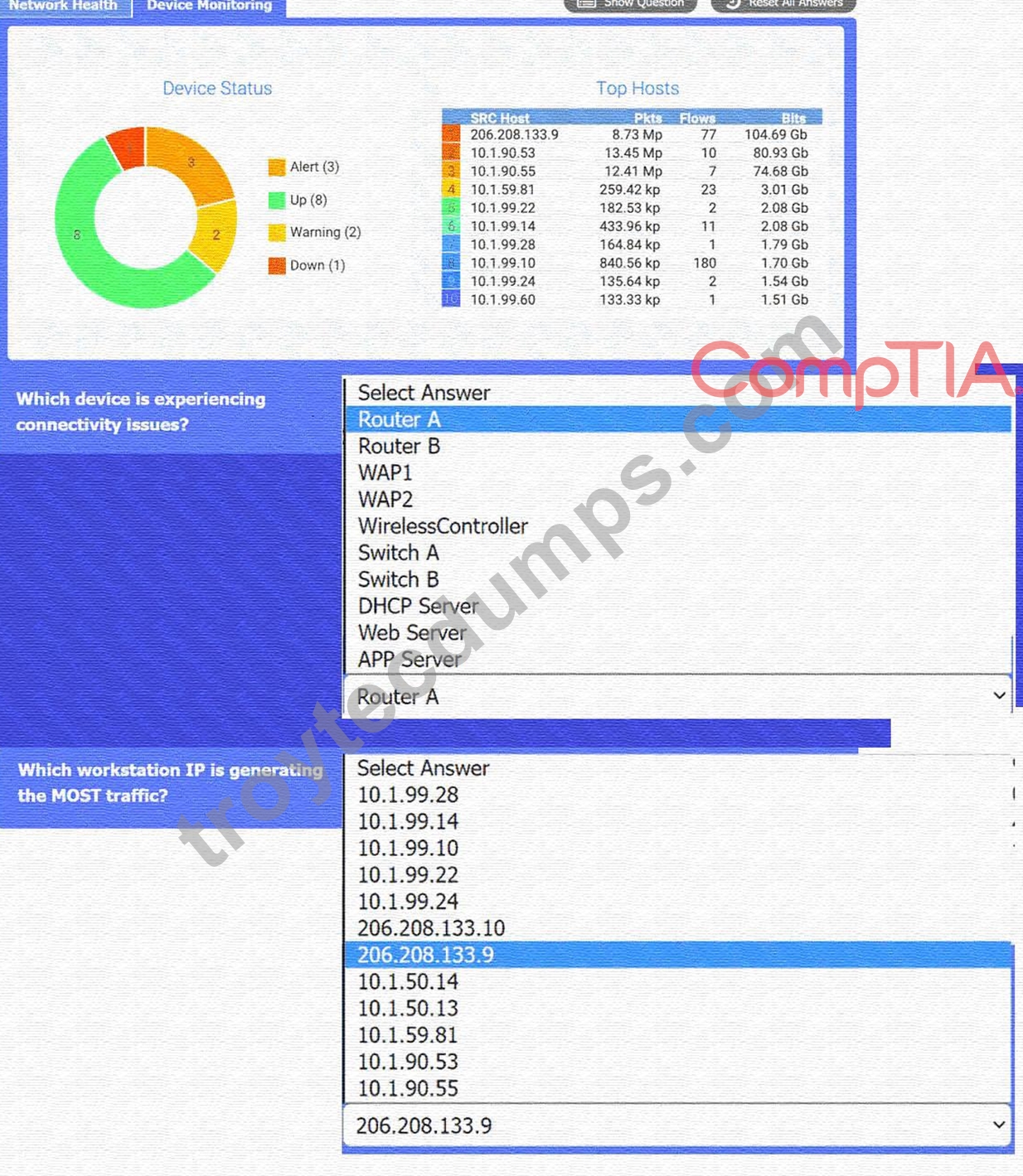
After a recent power outage, users are reporting performance issues accessing the application servers.
Wireless users are also reporting intermittent Internet issues.
INSTRUCTIONS
Click on each tab at the top of the screen. Select a widget to view information, then use the drop-down menus to answer the associated questions. If at any time you would like to bring back the initial state of the simulation, please click the Reset All button.
Answer:
Explanation:
See the answer and solution below.
Explanation:
Network Health:
WAN 2 appears to have a lower average latency and loss percentage, which would make it the preferred WAN station for VoIP traffic. VoIP traffic requires low latency and packet loss to ensure good voice quality and reliability. WAN 1 seems to have higher RAM and processor usage, which could also affect the performance of VoIP traffic.
Here ' s the summary of the key metrics for WAN 1 and WAN 2 from the image provided:
WAN 1:
Uplink Speed: 10G
Total Usage: 26.969GB Up / 1.748GB Down
Average Throughput: 353MBps Up / 23.42MBps Down
Loss: 2.51%
Average Latency: 24ms
Jitter: 9.5ms
WAN 2:
Uplink Speed: 1G
Total Usage: 930GB Up / 138GB Down
Average Throughput: 12.21MBps Up / 1.82MBps Down
Loss: 0.01%
Average Latency: 11ms
Jitter: 3.9ms
For VoIP traffic, low latency and jitter are particularly important to ensure voice quality. While WAN 1 has higher bandwidth and throughput, it also has higher latency and jitter compared to WAN 2. However, WAN 2 has much lower loss, lower latency, and lower jitter, which are more favorable for VoIP traffic that is sensitive to delays and variation in packet arrival times.
Given this information, WAN 2 would generally be preferred for VoIP traffic due to its lower latency, lower jitter, and significantly lower loss percentage, despite its lower bandwidth compared to WAN 1. The high bandwidth of WAN 1 may be more suitable for other types of traffic that are less sensitive to latency and jitter, such as bulk data transfers.
Device Monitoring:
the device that is experiencing connectivity issues is the APP Server or Router 1, which has a status of Down.
This means that the server is not responding to network requests or sending any data. You may want to check the physical connection, power supply, and configuration of the APP Server to troubleshoot the problem.
A screenshot of a computer AI-generated content may be incorrect.
NEW QUESTION # 240
Which of the following ports should a network administrator enable for encrypted login to a network switch?
- A. 0
- B. 1
- C. 2
- D. 3
Answer: C
Explanation:
Port 22 is used for Secure Shell (SSH), which enables encrypted remote login and command execution on network devices.
* Port 23 = Telnet (unencrypted)
* Port 80 = HTTP
* Port 123 = NTP
From Andrew Ramdayal's guide:
"SSH uses port 22 to provide secure command-line access to devices such as switches and routers. Unlike Telnet (port 23), SSH encrypts session traffic, making it the preferred method for remote administration."
NEW QUESTION # 241
SIMULATION
A network technician was recently onboarded to a company. A manager has tasked the technician with documenting the network and has provided the technician With partial information from previous documentation.
Instructions:
Click on each switch to perform a network discovery by entering commands into the terminal. Fill in the missing information using drop-down menus provided.


Answer:
Explanation:
See the Explanation for detailed information on this simulation
Explanation:
(Note: Ips will be change on each simulation task, so we have given example answer for the understanding) To perform a network discovery by entering commands into the terminal, you can use the following steps:
Click on each switch to open its terminal window.
Enter the command show ip interface brief to display the IP addresses and statuses of the switch interfaces.
Enter the command show vlan brief to display the VLAN configurations and assignments of the switch interfaces.
Enter the command show cdp neighbors to display the information about the neighboring devices that are connected to the switch.
Fill in the missing information in the diagram using the drop-down menus provided.
Here is an example of how to fill in the missing information for Core Switch 1:
The IP address of Core Switch 1 is 192.168.1.1.
The VLAN configuration of Core Switch 1 is VLAN 1: 192.168.1.0/24, VLAN 2: 192.168.2.0/24, VLAN 3: 192.168.3.0/24.
The neighboring devices of Core Switch 1 are Access Switch 1 and Access Switch 2.
The interfaces that connect Core Switch 1 to Access Switch 1 are GigabitEthernet0/1 and GigabitEthernet0/2.
The interfaces that connect Core Switch 1 to Access Switch 2 are GigabitEthernet0/3 and GigabitEthernet0/4.
You can use the same steps to fill in the missing information for Access Switch 1 and Access Switch 2.
NEW QUESTION # 242
A network technician is troubleshooting connectivity issues between two switches and determines that the crosstalk levels on the cable are high. Which of the following is most likely contributing to the high crosstalk?
- A. Inadequate termination
- B. Outside interference from adjacent cabling
- C. Lack of shielded twisted pair
- D. Use of Cat 6 cabling
Answer: A
Explanation:
Inadequate termination can disrupt the proper twisting and pairing of wires, increasing signal leakage between pairs and resulting in higher crosstalk levels.
NEW QUESTION # 243
Which of the following objectives does an evil twin achieve?
- A. ARP spoofing
- B. Login credentials
- C. DNS poisoning
- D. Denial of service
Answer: B
Explanation:
An evil twin attack is when an attacker sets up a rogue access point (AP) with the same SSID as a legitimate one to trick users into connecting. Once users connect, attackers often present fake login pages or capture unencrypted session data to steal login credentials.
A . DNS poisoning manipulates DNS resolution but is not inherent to evil twin.
C . ARP spoofing is a Layer 2 attack involving MAC/IP mapping manipulation.
D . Denial of service can be a side effect but is not the primary objective of evil twin attacks.
The main purpose of an evil twin is credential theft, enabling further unauthorized access to networks or systems.
NEW QUESTION # 244
......
Latest N10-009 Pass Guaranteed Exam Dumps Certification Sample Questions: https://lead2pass.troytecdumps.com/N10-009-troytec-exam-dumps.html