

[2026] Get Top-Rated CompTIA CS0-003 Exam Dumps Now
Passing Key To Getting CS0-003 Certified Exam Engine PDF
The CySA+ certification is an important credential for IT professionals who are looking to advance their careers in cybersecurity. CompTIA Cybersecurity Analyst (CySA+) Certification Exam certification is recognized by major tech companies and government agencies, and is a requirement for many cybersecurity jobs. The CySA+ certification is also a stepping stone to other advanced cybersecurity certifications, such as the Certified Information Systems Security Professional (CISSP) and Certified Ethical Hacker (CEH) certifications.
CompTIA CS0-003 (CompTIA Cybersecurity Analyst (CySA+) Certification) Exam is designed to assess the knowledge and skills of candidates in the field of cybersecurity analysis. CompTIA Cybersecurity Analyst (CySA+) Certification Exam certification exam is an esteemed qualification for cybersecurity analysts and is globally recognized in the industry. It is an intermediate-level certification, which means that candidates are required to have some prior knowledge and experience in this field before attempting the exam.
NEW QUESTION # 78
Which of the following BEST explains the function of trusted firmware updates as they relate to hardware assurance?
- A. Trusted firmware updates provide organizations with development, compilation, remote access, and customization for embedded devices.
- B. Trusted firmware updates provide organizations with secure code signing, distribution, installation, and attestation for embedded devices.
- C. Trusted firmware updates provide organizations with security specifications, open-source libraries, and custom toots for embedded devices.
- D. Trusted firmware updates provide organizations with remote code execution, distribution, maintenance, and extended warranties for embedded devices
Answer: B
Explanation:
Trusted firmware updates can help, with validation done using methods like checksum validation, cryptographic signing, and similar techniques.
NEW QUESTION # 79
A user downloads software that contains malware onto a computer that eventually infects numerous other systems. Which of the following has the user become?
- A. Hacklivist
- B. Advanced persistent threat
- C. Script kiddie
- D. Insider threat
Answer: D
Explanation:
Explanation
The user has become an insider threat by downloading software that contains malware onto a computer that eventually infects numerous other systems. An insider threat is a person or entity that has legitimate access to an organization's systems, networks, or resources and uses that access to cause harm or damage to the organization. An insider threat can be intentional or unintentional, malicious or negligent, and can result from various actions or behaviors, such as downloading unauthorized software, violating security policies, stealing data, sabotaging systems, or collaborating with external attackers.
NEW QUESTION # 80
During the log analysis phase, the following suspicious command is detected-
Which of the following is being attempted?
- A. ICMP tunneling
- B. Buffer overflow
- C. RCE
- D. Smurf attack
Answer: C
Explanation:
RCE stands for remote code execution, which is a type of attack that allows an attacker to execute arbitrary commands on a target system. The suspicious command in the question is an example of RCE, as it tries to download and execute a malicious file from a remote server using the wget and chmod commands. A buffer overflow is a type of vulnerability that occurs when a program writes more data to a memory buffer than it can hold, potentially overwriting other memory locations and corrupting the program's execution. ICMP tunneling is a technique that uses ICMP packets to encapsulate and transmit data that would normally be blocked by firewalls or filters. A smurf attack is a type of DDoS attack that floods a network with ICMP echo requests, causing all devices on the network to reply and generate a large amount of traffic. Verified References: What Is Buffer Overflow? Attacks, Types & Vulnerabilities - Fortinet1, What Is a Smurf Attack? Smurf DDoS Attack | Fortinet2, exploit - Interpreting CVE ratings: Buffer Overflow vs. Denial of ...3
NEW QUESTION # 81
A security analyst obtained the following table of results from a recent vulnerability assessment that was conducted against a single web server in the environment: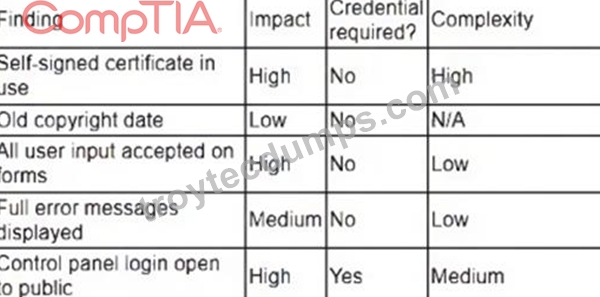
Which of the following should be completed first to remediate the findings?
- A. Purchase an appropriate certificate from a trusted root CA
- B. Perform proper sanitization on all fields
- C. Add the IP address allow listing for control panel access
- D. Ask the web development team to update the page contents
Answer: B
Explanation:
Explanation
The first action that should be completed to remediate the findings is to perform proper sanitization on all fields. Sanitization is a process that involves validating, filtering, or encoding any user input or data before processing or storing it on a system or application. Sanitization can help prevent various types of attacks, such as cross-site scripting (XSS), SQL injection, or command injection, that exploit unsanitized input or data to execute malicious scripts, commands, or queries on a system or application. Performing proper sanitization on all fields can help address the most critical and common vulnerability found during the vulnerability assessment, which is XSS.
NEW QUESTION # 82
Which of the following threat actors is most likely to target a company due to its questionable environmental policies?
- A. Hacktivist
- B. Nation-state
- C. Lone wolf
- D. Organized crime
Answer: A
NEW QUESTION # 83
A malicious actor has gained access to an internal network by means of social engineering. The actor does not want to lose access in order to continue the attack. Which of the following best describes the current stage of the Cyber Kill Chain that the threat actor is currently operating in?
- A. Delivery
- B. Weaponization
- C. Reconnaissance
- D. Exploitation
Answer: D
Explanation:
The Cyber Kill Chain is a framework that describes the stages of a cyberattack from reconnaissance to actions on objectives. The exploitation stage is where attackers take advantage of the vulnerabilities they have discovered in previous stages to further infiltrate a target's network and achieve their objectives. In this case, the malicious actor has gained access to an internal network by means of social engineering and does not want to lose access in order to continue the attack. This indicates that the actor is in the exploitation stage of the Cyber Kill Chain. Official References: https://www.lockheedmartin.com/en-us/capabilities/cyber/cyber-kill- chain.html
NEW QUESTION # 84
A security administrator is tasked with modifying the vulnerability scan process to reduce the network traffic but maintain thorough checks. Which of the following scanning approaches should be implemented?
- A. Security baseline scans
- B. Credentialed scans
- C. Individual scans
- D. Agent-based scans
Answer: D
Explanation:
Agent-based scans are run locally on hosts via installed agents, which significantly reduces network traffic while allowing in-depth visibility and accurate scanning. They're ideal for bandwidth-limited or sensitive networks.
Credentialed scans (A) still transmit data over the network.
Individual scans (B) is ambiguous and not a standard term.
Baseline scans (C) focus on policy compliance, not reducing traffic.
? Reference:
Chapple & Seidl - Vulnerability Management, Chapter 6: Scanning Techniques CS0-003 Domain 2.1 - Vulnerability Scanning Methods
NEW QUESTION # 85
When undertaking a cloud migration of multiple SaaS applications, an organization's systems administrators struggled with the complexity of extending identity and access management to cloud-based assets. Which of the following service models would have reduced the complexity of this project?
- A. RADIUS
- B. ZTNA
- C. SDN
- D. SWG
Answer: B
Explanation:
Zero Trust Network Access centralizes and simplifies identity-based access control for cloud resources. By using strong authentication and policy-driven access tied to user identity, ZTNA reduces the complexity of extending IAM across multiple SaaS applications during cloud migration.
NEW QUESTION # 86
The SOC received a threat intelligence notification indicating that an employee's credentials were found on the dark web. The user's web and log-in activities were reviewed for malicious or anomalous connections, data uploads/downloads, and exploits. A review of the controls confirmed multifactor authentication was enabled. Which of the following should be done first to mitigate impact to the business networks and assets?
- A. Perform a forced password reset.
- B. Communicate the compromised credentials to the user.
- C. Lower the thresholds for SOC alerting of suspected malicious activity.
- D. Perform an ad hoc AV scan on the user's laptop.
- E. Review and ensure privileges assigned to the user's account reflect least privilege.
Answer: A
Explanation:
The first and most urgent step to mitigate the impact of compromised credentials on the dark web is to perform a forced password reset for the affected user. This will prevent the cybercriminals from using the stolen credentials to access the company's network and systems. Multifactor authentication is a good security measure, but it is not foolproof and can be bypassed by sophisticated attackers. Therefore, changing the password as soon as possible is the best practice to reduce the risk of a data breach or other cyber attack123 Reference: 1: How to monitor the dark web for compromised employee credentials 2: How to prevent corporate credentials ending up on the dark web 3: Data Breach Prevention: Identifying Leaked Credentials on the Dark Web
NEW QUESTION # 87
During a tabletop exercise, engineers discovered that an ICS could not be updated due to hardware versioning incompatibility. Which of the following is the most likely cause of this issue?
- A. Degrading functionality
- B. Configuration management
- C. Business process interruption
- D. Legacy system
Answer: D
Explanation:
The most likely cause of the issue where an ICS (Industrial Control System) could not be updated due to hardware versioning incompatibility is a legacy system. Legacy systems often have outdated hardware and software that may not be compatible with modern updates and patches.
This can pose significant challenges in maintaining security and operational efficiency.
NEW QUESTION # 88
During an incident in which a user machine was compromised, an analyst recovered a binary file that potentially caused the exploitation. Which of the following techniques could be used for further analysis?
- A. Fuzzing
- B. Packet capture
- C. Sandboxing
- D. Static analysis
Answer: D
NEW QUESTION # 89
Which of the following is an important aspect that should be included in the lessons-learned step after an incident?
- A. Discuss the financial impact of the incident to determine if security controls are well spent
- B. Identify any improvements or changes in the incident response plan or procedures
- C. Determine if an internal mistake was made and who did it so they do not repeat the error
- D. Present all legal evidence collected and turn it over to iaw enforcement
Answer: B
Explanation:
An important aspect that should be included in the lessons-learned step after an incident is to identify any improvements or changes in the incident response plan or procedures. The lessons-learned step is a process that involves reviewing and evaluating the incident response activities and outcomes, as well as identifying and documenting any strengths, weaknesses, gaps, or best practices. Identifying any improvements or changes in the incident response plan or procedures can help enhance the security posture, readiness, or capability of the organization for future incidents
NEW QUESTION # 90
A company's user accounts have been compromised. Users are also reporting that the company's internal portal is sometimes only accessible through HTTP, other times; it is accessible through HTTPS. Which of the following most likely describes the observed activity?
- A. An on-path attack is being performed by someone with internal access that forces users into port 80
- B. The web server cannot handle an increasing amount of HTTPS requests so it forwards users to port 80
- C. There is an issue with the SSL certificate causinq port 443 to become unavailable for HTTPS access
- D. An error was caused by BGP due to new rules applied over the company's internal routers
Answer: A
Explanation:
An on-path attack is a type of man-in-the-middle attack where an attacker intercepts and modifies network traffic between two parties. In this case, someone with internal access may be performing an on-path attack by forcing users into port 80, which is used for HTTP communication, instead of port 443, which is used for HTTPS communication. This would allow the attacker to compromise the user accounts and access the company's internal portal.
NEW QUESTION # 91
The Chief Information Security Officer (CISO) of a large financial institution is seeking a solution that will block a predetermined set of data points from being transferred or downloaded by employees. The CISO also wants to track the data assets by name, type, content, or data profile.
Which of the following BEST describes what the CIS wants to purchase?
- A. File integrity monitor
- B. DLP
- C. SIEM
- D. Asset tagging
Answer: B
NEW QUESTION # 92
An analyst is reviewing system logs while threat hunting: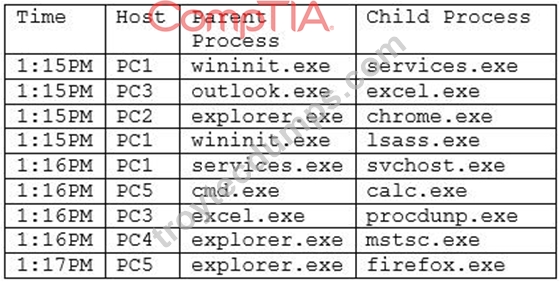
Which of the following hosts should be investigated first?
- A. PC1
- B. PC3
- C. PC4
- D. PC2
- E. PC5
Answer: E
NEW QUESTION # 93
A corporation wants to implement an agent-based endpoint solution to help:
- Flag various threats
- Review vulnerability feeds
- Aggregate data
- Provide real-time metrics by using scripting languages
Which of the following tools should the corporation implement to reach this goal?
- A. SOAR
- B. NAC
- C. Heuristics
- D. DLP
Answer: A
NEW QUESTION # 94
During an incident, a security analyst discovers a large amount of PII has been emailed externally from an employee to a public email address. The analyst finds that the external email is the employee's personal email. Which of the following should the analyst recommend be done first?
- A. Disable the public email access with CASB.
- B. Enable filtering on the web proxy.
- C. Place a legal hold on the employee's mailbox.
- D. Configure a deny rule on the firewall.
Answer: C
NEW QUESTION # 95
Which of the following best explains the importance of utilizing an incident response playbook?
- A. It prioritizes the business-critical assets for data recovery.
- B. It establishes actions to execute when inputs trigger an event.
- C. It documents the organization asset management and configuration.
- D. It defines how many disaster recovery sites should be staged.
Answer: B
NEW QUESTION # 96
A security analyst is reviewing events that occurred during a possible compromise. The analyst obtains the following log: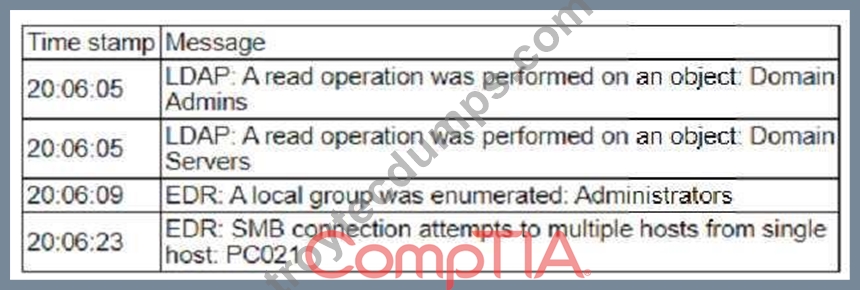
Which of the following is most likely occurring, based on the events in the log?
- A. An adversary is performing a vulnerability scan.
- B. An adversary is performing a password stuffing attack.
- C. An adversary is attempting to find the shortest path of compromise.
- D. An adversary is escalating privileges.
Answer: A
Explanation:
Based on the events in the log, the most likely occurrence is that an adversary is performing a vulnerability scan. The log shows LDAP read operations and EDR enumerating local groups, which are indicative of an adversary scanning the system to find vulnerabilities or sensitive information. The final entry shows SMB connection attempts to multiple hosts from a single host, which could be a sign of network discovery or lateral movement.
NEW QUESTION # 97
A security analyst reviews the following Arachni scan results for a web application that stores PII data: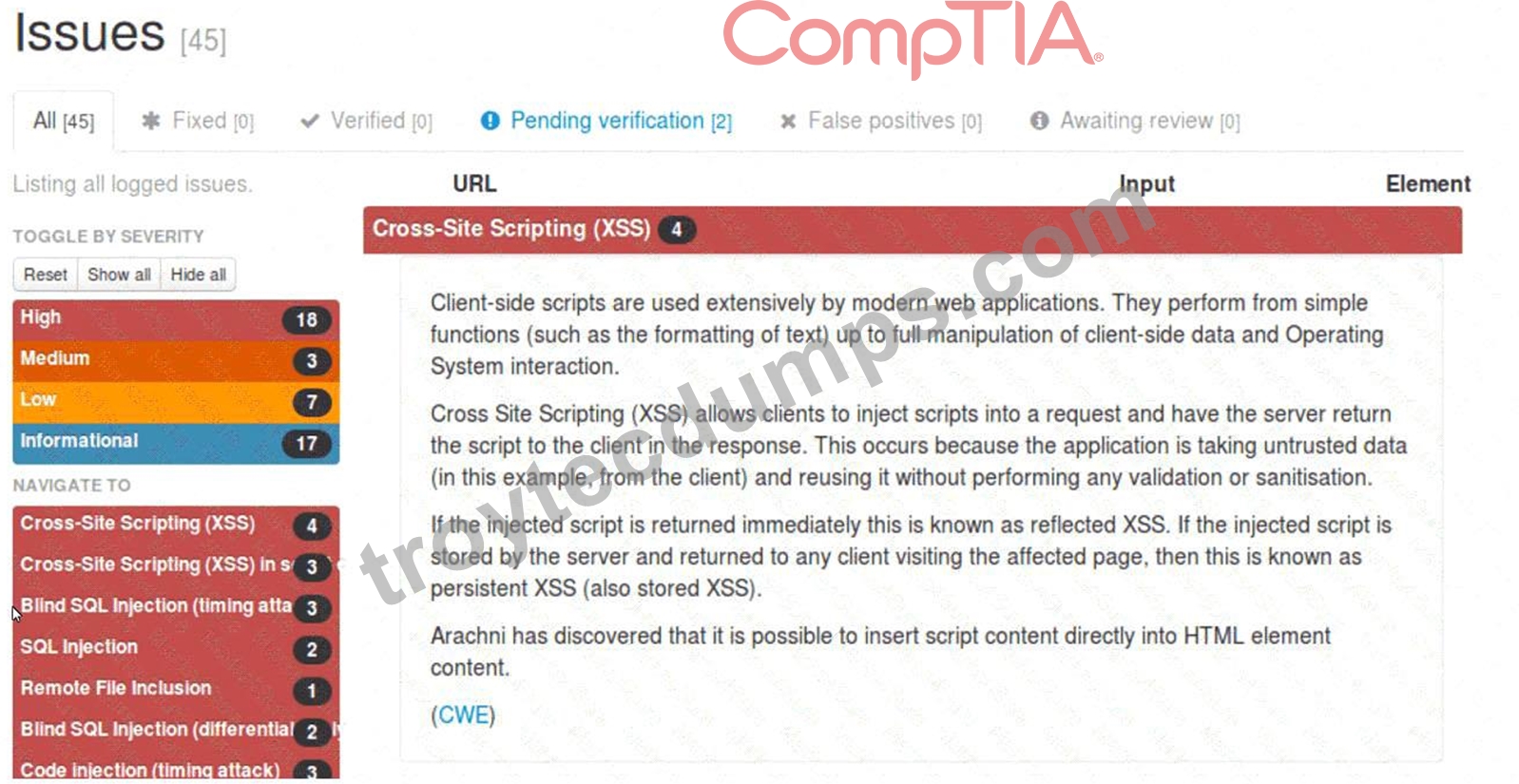
Which of the following should be remediated first?
- A. Code injection
- B. RFI
- C. SQL injection
- D. XSS
Answer: C
Explanation:
SQL injection should be remediated first, as it is a high-severity vulnerability that can allow an attacker to execute arbitrary SQL commands on the database server and access, modify, or delete sensitive data, including PII. According to the Arachni scan results, there are two instances of SQL injection and three instances of blind SQL injection (two timing attacks and one differential analysis) in the web application.
These vulnerabilities indicate that the web application does not properly validate or sanitize the user input before passing it to the database server, and thus exposes the database to malicious queries12. SQL injection can have serious consequences for the confidentiality, integrity, and availability of the data and the system, and can also lead to further attacks, such as privilege escalation, data exfiltration, or remote code execution34.
Therefore, SQL injection should be the highest priority for remediation, and the web application should implement input validation, parameterized queries, and least privilege principle to prevent SQL injection attacks5. References: Web application testing with Arachni | Infosec, How do I create a generated scan report for PDF in Arachni Web ..., Command line user interface Arachni/arachni Wiki GitHub, SQL Injection - OWASP, Blind SQL Injection - OWASP, SQL Injection Attack: What is it, and how to prevent it., SQL Injection Cheat Sheet & Tutorial | Veracode
NEW QUESTION # 98
During the log analysis phase, the following suspicious command is detected:
Which of the following is being attempted?
- A. ICMP tunneling
- B. Buffer overflow
- C. RCE
- D. Smurf attack
Answer: C
Explanation:
RCE stands for remote code execution, which is a type of attack that allows an attacker to execute arbitrary commands on a target system. The suspicious command in the question is an example of RCE, as it tries to download and execute a malicious file from a remote server using the wget and chmod commands. A buffer overflow is a type of vulnerability that occurs when a program writes more data to a memory buffer than it can hold, potentially overwriting other memory locations and corrupting the program's execution. ICMP tunneling is a technique that uses ICMP packets to encapsulate and transmit data that would normally be blocked by firewalls or filters. A smurf attack is a type of DDoS attack that floods a network with ICMP echo requests, causing all devices on the network to reply and generate a large amount of traffic.
NEW QUESTION # 99
Which of the following risk management decisions should be considered after evaluating all other options?
- A. Mitigation
- B. Transfer
- C. Acceptance
- D. Avoidance
Answer: C
Explanation:
* Risk Acceptance means acknowledging a risk and choosing not to take further action because the cost of mitigation may outweigh the benefits.
* It is the last resort when:
* The risk is low impact or unlikely to occur.
* Other options (mitigation, transfer, avoidance) are not feasible.
Why Not Other Options?
* A (Transfer) # Moving risk to a third party (e.g., insurance).
* C (Mitigation) # Implementing security controls to reduce risk.
* D (Avoidance) # Eliminating the risk entirely (e.g., discontinuing a service).
NEW QUESTION # 100
A virtual web server in a server pool was infected with malware after an analyst used the internet to research a system issue. After the server was rebuilt and added back into the server pool, users reported issues with the website, indicating the site could not be trusted. Which of the following is the most likely cause of the server issue?
- A. The server was supporting weak TLS protocols for client connections.
- B. The malware infected all the web servers in the pool.
- C. The digital certificate on the web server was self-signed
- D. The server was configured to use SSI- to securely transmit data
Answer: C
Explanation:
A digital certificate is a document that contains the public key and identity information of a web server, and is signed by a trusted third-party authority called a certificate authority (CA). A digital certificate allows the web server to establish a secure connection with the clients using the HTTPS protocol, and also verifies the authenticity of the web server. A self-signed certificate is a digital certificate that is not signed by a CA, but by the web server itself. A self-signed certificate can cause issues with the website, as it may not be trusted by the clients or their browsers. Clients may receive warnings or errors when trying to access the website, indicating that the site could not be trusted or that the connection is not secure. Official References:
https://www.comptia.org/blog/the-new-comptia-cybersecurity-analyst-your-questions-answered
https://partners.comptia.org/docs/default-source/resources/comptia-cysa-cs0-002-exam-objectives
https://www.techtarget.com/searchsecurity/quiz/Sample-CompTIA-CySA-test-questions-with-answers
NEW QUESTION # 101
A laptop that is company owned and managed is suspected to have malware. The company implemented centralized security logging. Which of the following log sources will confirm the malware infection?
- A. XDR logs
- B. MFA logs
- C. Firewall logs
- D. IDS logs
Answer: A
Explanation:
XDR logs will confirm the malware infection because XDR is a system that collects and analyzes data from multiple sources, such as endpoints, networks, cloud applications, and email security, to detect and respond to advanced threats12. XDR can provide a comprehensive view of the attack chain and the context of the malware infection. Firewall logs, IDS logs, and MFA logs are not sufficient to confirm the malware infection, as they only provide partial or indirect information about the network traffic, intrusion attempts, or user authentication. References: Cybersecurity Analyst+ - CompTIA, XDR: definition and benefits for MSPs| WatchGuard Blog, Extended detection and response - Wikipedia
NEW QUESTION # 102
......
CS0-003 exam questions for practice in 2026 Updated 668 Questions: https://lead2pass.troytecdumps.com/CS0-003-troytec-exam-dumps.html